Wednesday, May 15, 2013

Why should I bother with this homework?


Dear Teacher,

In this standards based grading system, my classmates tell me that homework doesn't count, that I don't get any "credit" for doing it.  Why should I bother doing it or doing it well the first time if I just get to re-do it?

Sincerely,
Your Student


Dear Student,

     Thank you for your question and your openness. I'd like to help you change a misconception you have about homework not "counting" and share some perspectives I have about the role of homework in my class and in learning.  My hope for you is that in a few years you will graduate and maybe go to college. If you don't go to to college, that's ok too, but I want you to find a job or career that brings you success and happiness.  In most jobs and careers there will not be homework. There will only be the job or tasks that need to be accomplished. Your boss will care mostly about results.  You will need to ask yourself "Have I done the work that I needed to do to help  the company achieve their goals in the most efficient way possible? Have I done enough to keep my job or even advance into new challenging ones?"  The kinds of skills you will need will be hard work, perseverance, adaptability, collaboration, communication and a willingness to learn new skills and content on your own time.  At its simplest level, your motivation will be to maintain your job and earn a secure paycheck. At a more sophisticated  level, I hope your motivation will be to push yourself harder and further than you ever can in reaching your goals and dreams.

      Back to the issue of homework. I don’t like to give homework and I often feel that if we have both done our job in class together, there may not be a need for any at all. However,  in my class , if and when I  give you homework, there will be four kinds with four very different purposes. The first will be preview. I might ask you to explore the kinds of things that will help you to build some basic background knowledge. It might be a bit of reading, it might be a few problems to try, it might be to watch a brief video. The purpose will be to help you have a context for learning either the next day in class or somewhere down the road. This homework shouldn't take you a long time to do. It's purpose is to "prime the pump" so to speak.  Typically, everyone in the class will be given this homework (if my pre-assessments tell me that most students do not understand the concept or have the background knowledge yet). I won't be assessing this work but you will absolutely be expected to use this new information in class the next day during discussions with peers and within the activities we do together.  If you don’t do them,  you might  feel like you might have missed something during the class discussion. But you will still have time to catch up with us. I might ask you to do the reading or watch the video while the rest of us are doing something else together. This is not a punishment. It is laying a foundation you will need to be more successful.  Remember, when you have a job someday, you will need to begin to learn new things on your own to stay up to date with new technologies, new information, and new ideas to bring back to your company.

      The next kind of homework I will sometimes give you is practice.  At home practice is needed when the evidence you provide me in class shows me that you need to try it a few more times to truly "get it". I will do my best to help you in class, give you time to work with peers and practice with them. I will also do my best to make sure you understand a concept at a basic level before asking you to go home and practice it some more.  When I ask you to practice something, chances are, not everyone in class will have the same type of practice as you. And some students may not need the practice at all.  There will be times when you will not need the practice either. This is not a punishment. It is meant to help you become better at something you might not be very good at yet.  And sometimes, you might already understand and can do it, but I want to challenge you to reach beyond what you think you know and can do. Don't shy away from this challenge. Embrace it.
   
   If you show proficiency in the practice homework, it will always be considered as evidence in  your overall "grade" for that learning target, but it's ok to struggle and it's ok to not get it the first time.We know that the best kinds of practice are those in which we practice something we can not yet do well.  To FAIL means  your First Attempt In Learning and it wouldn't be fair of me to lump the first, second, or even third attempts as "evidence". I am going to use all of these attempts (both inside and outside) to help you get to where you need to go and to do what you need to be able to do. When I give you practice types of homework, they will be respectful of you as a learner. I promise to give you practice that is both at your individual level of need as well as not overbearing on your time at home. We will use this practice together to help you become proficient at the skills you need to shore up.  I will provide you feedback that is timely, actionable, and respectful to you as a learner.   Remember, when you have a job someday, you will need to practice the skills, learn new skills, and improve upon them to help make your company grow and achieve their goals.

     The next kind of homework will be performance or evidence. This homework will require you to apply all of the practice in a new way. It will prove to me that you understand and can do the work. Typically, this homework won't be given very often, but it will help me to see you as a learner in a new way if I do not have enough evidence in class. This kind of work will ask you to think critically and creatively. It will help me to see if all of the preview and practice has paid off. It will be a piece of evidence we use to help us decide together whether you truly understand and can do the target we set before you.  Not everyone in class will have the same type of performance task as you. And some students may not have an outside of class performance task at all.  There will be times when you will not need to do a performance task out of class either. This is not a punishment. It is intended to give you another opportunity and for me to collect more evidence of what you know and can do.  Part of this process will involve you assessing yourself and reflecting on what you know and can do. I will provide you feedback that is timely,  actionable, and respectful of you as learner so that you can improve upon future learning.  If you have done the hard work in class and on the occasional practice I have asked you to do at home, performance based homework should confirm what we both know about you as a learner. It should tell us that you are proficient or advanced.  If it doesn't, we will need to go back and practice some more. And this is ok, because I will never stop helping you, and I will never allow you to quit.  Remember, when you have a job someday, you will be asked to perform. You will be asked to see a process through until the very end. You will be evaluated on it and given feedback on how you can improve. But if you don't use the grit, perseverance, and passion to learn throughout the entire process, the final piece will show that you did not use all of the right tools in your toolbox to achieve the goal. This is why we need to give our maximum effort at all times, to try our hardest the first time.  We can never be our personal best if we hold back at any point in the process.

     The last kind of homework in my class will be the homework that I never assign to you. My hope for you is that on a daily basis you will be engaging in personally meaningful and challenging learning experiences and that you will want to continue doing that when you leave my class. My hope is that you will talk to your friends and family about what you are learning and the challenges you are facing. My hope is that you will seek out new information from other experts and from the internet to help support the learning you are doing in my class. My hope is that each night you will review your notes and/or reflect on the learning we did in class to help prepare you for the next day's challenges. My hope is that you will recognize the need to continuously improve and learn and that your opportunities for learning will never stop, even when traditional schooling ends.

     In the end, the most important thing for you to understand is that I will not allow you to take the easy way out. I will not allow you to settle. You will work hard and you will struggle at times. I will never let you stop and I will always demand your very best. I will do my very best to make every "at home" assignment I choose to give you,  relevant to you and worth your time commitment. In return, I expect you to complete them to the best of your ability. When you don't, I will give them back to you and demand a better effort. I will not give you feedback for improvement until you do. When you do not turn things in or do not turn them in on time, there will be consequences, such as pulling you from lunch or requiring you to stay after school with me to show me evidence of your learning. This will not be detention. It will be time we will spend together to talk about your choices and help you make the best choices for your learning in the future. My goal is to ensure you are learning and reaching your maximum potential. You may get more "homework" from me than in the past or you may get less than you are used to. No matter what, my goal will always be to help you be successful and learn to your greatest potential.

Sincerely,
Your Teacher

Wednesday, May 8, 2013

What do you want your classroom to be like?

       A colleague of mine likes to ask the question: "What do you want your classroom to be like?"  It would be easy for most teachers to answer this question rather reflexively. At the same time,  challenge yourself to let it simmer before responding. Reflect. Dig deep. Don't focus on what it currently looks and feels like. Don't focus on what it isn't. Don't get stuck thinking about what is getting in the way.  Focus on what you dream it could be like. Create a vision for your classroom. What do you want your classroom to be like? 

My rough draft looked like this:

I want my classroom to be more

  • risk taking and mistake making and less playing it safe 
  • collaboration and connectivity and less isolation
  • questions and less answers
  • student autonomy and less teacher directed
  • growth mindset and less fixed mindset
  • passion and interest driven and less standardized 
  • personalized and less whole group 
  • authentic and like the real world and less like school
  • fun and less boring 
  • creating and less consuming
  • thinking critically and less recall
  • about effort, persistence and grit and less giving up
  • transparent and less behind closed door
  • feedback and less grading
  • caring for one another and less selfishness
  • evidence than opinion

I'm sure I could add to this list and while all of these are important and integral as my personal philosophies as a teacher, I also believe that they could all be summed up in one statement: 

I want my classroom to be a place where each and every student has an opportunity to learn and grow in whatever ways they need. 

 Disclaimer: For those who know me well, you might be surprised that I did not  include a statement  about a classroom rich with technology. Consciously, I left that off my list because the classroom I envision cannot be effectively or efficiently created or sustained without technology embedded and integrated into everything we do.  We are 13 years into the 21st Century and we keep referencing 21st century skills and technology as illusive and disconnected goals in learning (ie. How do I have time to teach all this other stuff?) Technology in education  is not about a laptop or tablet or SMART board or clicker. It is not about a web tool or skype or social media . It is about matching the right learning tool with the right child at the right time to guarantee that that child has learned.  Settling for anything else is just an excuse. 


Wednesday, April 24, 2013

More empathy, less apathy


"Treat people with understanding when you can, and fake it when you can't until you do understand."- Kim Harrison

I'm going to admit publicly that there was a time I uttered the phrase "It must be nice to be an administrator. No lesson plans, no grading. They are never around. Always in meetings and who knows what they do?" Admit it. You've probably said it too.  I'm not proud of it.  But an interesting thing happened to me in my new role as a full time learning coach. I began to see the many different roles we all play in helping students learn. And I have had colleagues tell me "It must be nice to be a coach. No lesson plans, no grading. We never see you. You are always in meetings. What exactly do you do again?" It doesn't feel so nice.

This post is not about me justifying my job as a coach, nor is it about making others feel bad for me. It's about empathy. It's about trying to see things from a different perspective. It's about teachers being willing to explore more than just their own classroom needs. It's about administrators being willing to put aside their building or district needs to help support the realities of each individual classroom teacher and their students. It's about us checking our ego at the door and doing what is best for all. It's about committing to more communication and collaboration.  It's about each of us seeking to understand the vital and important role we each play in the life of every child who walks through our doors. As Angela Maiers would say it's truly believing that each and every one of us matters.

As teachers, we are quick to shift the burden of blame onto our colleagues, our building principal, district administration, parents and far too often: onto our students. So here is my challenge to you: The next time you find yourself blaming someone (or something)  else: stop, pause, count to ten, and then try and envision the life and experiences of the person you are blaming. Think about what they might be feeling about this situation. Think about what their reality might be like. Try and put yourself in their shoes. Try to see the world through their eyes.  Ask yourself why they make the choices they do. Don't accuse them. Don't judge them. Don't put them into a  little box. Don't label them.  This is tough work. Especially if you don't know them well or have rarely engaged in deep conversation with them.

Now here comes the tougher part: Go sit beside them and genuinely seek to understand them and the decisions they have made.

Ask them for their perspective. Ask them to share their ideas and philosophies. Don't question or challenge them. Seek to understand. Listen. Be present with them. Take the time to establish a relationship built on honest dialogue and respect. It does not mean you must agree with them.  Acknowledge their truths. Don't try to fix them or change them. Accept that their perceptions are their realities.

Far too many believe that what ails public education is out of their control. What we can control is how we relate to one another. If you are a teacher: When was the last time you had an honest and respectful  conversation with a colleague you disagreed with? When was the last time you had an honest and respectful conversation with your building principal about the culture and structures of the building? When was the last time you went and sat in the office of the superintendent and had an honest and respectful conversation about your hopes and dreams for the students in your district?  If you are an administrator: When was the last time you asked your teachers to share their perspectives on the culture of your building? When was the last time you sat down one on one with a teacher and asked them about their vision and dreams?   When was the last time you opened up about your own dreams for your school?

We all have responsibility in seeking out and continuing the conversation.  As teachers, we speak of being frustrated, paralyzed, demoralized, and  apathetic. But we are not in this boat alone. We row alongside students, parents, and administrators who are equally frustrated, paralyzed, demoralized, and apathetic because they feel that their voice is lost and that they too are misunderstood. We will always have differences in opinion and perspective. We will always have different experiences that shape our realities. But we have much more in common than we realize. More importantly, we have the one true thing in common: a love and desire to help others learn and grow.

We can change the culture of our classrooms, buildings, and communities one conversation at a time. We can eliminate a culture of blame.  It begins with empathy. Seek to understand. And fake it until you finally do.


Wednesday, April 10, 2013

Collaboration is not a time, it's a mindset.


Although it has always been true, the need for collaboration has become an increasingly vital aspect of supporting student learning in schools today. PLC’s (as defined by DuFour and Marzano ) cannot function effectively without a collaborative spirit: collaboratively created goals, collaboratively collected data and analysis, and collaboratively problem-solved. For educators, the term “collaboration” truly means different things and without getting into all those visions, the one aspect that seems to get in the way of “collaboration” is time.  “If we were just given time to collaborate, we would do it more.” is often echoed across the educational landscape.  While no one will argue that time is not a factor, there are ways to utilize technology to create efficiency before and during the collaborative process.  
In our school district we have various district provided tools that should support the collaborative mindset. Being a Google Apps for Education district provides synchronous collaboration primarily through Google Docs as well as Google+, and Google Hangouts. . As part of the Blended Schools consortium, we also have access to a wide range of collaborative tools in Blackboard such as BBim (instant messaging) and BB Collaborate which provides a powerful real time virtual classroom with whiteboards, screen sharing, and break out rooms.  Teachers have access to Skype, unfiltered access to Twitter, and in the coming months, an upgrade to Microsoft’s newest cloud based services: Office 365 for education. Even in a district who does not make these resources readily available, throw in the ability to use wiki’s, youtube and other video sharing sites, and participating in learning communities and you have opportunities for collaboration not only across schools but across continents and oceans as well. We exist in a time where collaboration is  more possible now  than ever before and it can transcend physical location...and time.
In a local school or district, collaboration is often referred to as a “time” when in reality, it needs to be  a mindset. As educators, we shouldn’t wait for “time”  provided for us to collaborate when we have access to so many different tools to begin and support the process. School and district leadership who value collaboration acknowledge the significance and importance of face to face collaboration and schedule it as often as possible.  These opportunities need to be more available than just two or three times a year. And while having dedicated time daily would be ideal, the realities and economics of public education in America just won’t support this on a large scale. The truth is, as educators we need to accept that a collaborative mindset requires us to recognize that frequent face to face collaboration with all members of a PLC is not likely or even realistic.
A wise principal in my district (@debglock) once asked “What can we do on a professional development day (non-instructional day)  that we can’t do any other way? What can we do during a faculty meeting that we can’t do any other way?”  I love these questions because they imply that we need to maximize the usefulness and impact of the precious time we spend face to face.   This question applies to teacher collaboration as well. “What can we do in our face to face collaboration that can’t be done in another way?”  Thinking like this requires commitment, perseverance, transparency, patience,  honesty, trust,  flexibility and a willingness to learn and communicate in different (and sometimes better) ways.  Interestingly, these are the same kinds of skills we wish our students to exemplify.
If we are being honest with one another, we don’t always maximize our face to face time either. We spend it complaining, gossiping, and in task avoidance. We aren’t always willing to listen to one another’s ideas and core beliefs. We aren’t always willing to admit our own failures.  We aren’t always willing to engage in the hard conversations that hold one another accountable to the goal or the process. We aren’t always willing to help our colleagues come to their own new learnings. We often take the conversations that happen behind closed doors and judgmentally share them with other colleagues.  In other words, we aren’t always the best collaborators. We say we want more collaboration, but what would we do with it if we were given the opportunity?
The collaborative mindset is less about the tools we use to accomplish our goals and more about the desire to do whatever it takes to help students learn. The good news is, all of this is in our control. All of us can commit to one another to maximize the face to face time engaging in the deep and meaningful conversations. We can all take on the necessary roles to function as an effective and collaborative PLC. We can be honest and establish and support trusting relationships with one another. We can be transparent about our goals,  process, and results while also maintaining and rewarding the confidence of our colleagues and their opinions.  We can be open to trying new means of communicating, sharing, and working through digital tools that help keep the process and conversation ongoing between face to face meetings. Collaboration is an ongoing  conversation. It is not a time. It is a mindset.

This post is cross posted on the Digital Learning Environment's website blog.

Tuesday, March 26, 2013

It's not the kids who are failing.


Several years go, after participating in several cohorts of Powerful Learning Practices with Sheryl Nussbaum Beach and Will Richardson and with the support of another fantastic mentor in Robin Ellis, I realized that I had a lot of unlearning to do. One of the most challenging shifts for me to grapple with was to acknowledge that I was entirely too focused on what I was doing as a teacher and not enough on my students learning. What makes this so difficult for us as educators  is that this attitude or mindset often leaves us in an uncomfortable state of tension. That tension exists because of what we think we know to be true about teaching and what the reality of learning is for students. We know that teachers have a tremendous impact on student learning, but it's not necessarily in ways that we traditionally think.

As educators, we face a generation of students who appear to be disengaged, unmotivated, and unwilling to learn in school.  Yet, this is also a generation with more access to information,  an immense will to connect with one another and the world beyond them, and an intrinsic desire to be creative and innovative.  Our students are learning. It's just that they are doing it outside of school, without us.  Certainly there is argument on both sides of the debate as to whether this type of  less structured,  self driven learning will actually produce a generation of "well-educated" Americans (as if anyone has EVER defined that well).  Want evidence, just google the  MOOC debate occurring in higher ed. 

What has also become glaringly obvious to me is that many schools and classrooms rarely include students in  the decision making process. And I'm not referring to a Student Government or Student Advisory Council which are both fantastic opportunities for students to have a voice. How often do we ask students how they want to learn? How often do we ask students what they would like to create? How often do we involve students in the design process? How often to do we ask them to co-create rubrics or determine what success looks like in THEIR growth and learning?

As a history teacher, I love to tell stories. It's inherent in what I do and it's part of my instructional toolbelt. We know that storytelling is paramount to understanding the past and making connections to modern life, yet if the same person is always telling the story (ie. the teacher) there is little learning that is occurring. Perhaps the kids are being passively entertained. Maybe the kids are being politely compliant.  But if they aren't the ones telling the story, there is a limited chance that they will retain the story, let alone apply it or construct meaning from it. 

In the debate over what it means to be  "career and college ready"  (as defined by CCSS) most educators can agree that one of the goals is to help support successful self-directed learning and learners. Yet somehow we seem to be missing a voice, a story: the students. As educators, we know a thing or two about content and pedagogy. We attempt to marry the art of teaching with the science of teaching. We utilize the brain based research equally with what our own guts tell us. Yet despite all of our training and experience, learning is magic(al) and mysterious.  The only way to change that is to give control of learning over to the stakeholders themselves: the students. 

If we continue to make every decision for our students about what to learn, how to learn it, and when to do it, we can not call them disengaged, or lazy, or incapable of achievement. If we control every part of their school day, their lack of engagement, their lack of effort, their lack of learning is actually a reflection on us. No matter what one-size fits all strategy we employ, no matter what "traditional" teaching methods we cling to, no matter what new innovative technologies we believe will transform our classrooms, if our students do not have control over their own learning journey's, we are failing them. 


Tuesday, March 12, 2013

Make it work for learning.


When we discuss the purchase of technology,  one of the main debates is typically over whether we will get enough student learning for our financial investment. As we know, a SMART board does not make a smart teacher.  And putting a tablet or laptop in the hand of every child does not guarantee growth either. Realizing that this is an oversimplification of a somewhat complicated scenario, what I hear most often debated is not student readiness, but teacher readiness.The debate becomes a chicken or egg scenario. Do we buy the “stuff”  first and then professionally develop our staff so they can use it with their students or do we try and build capacity, a tipping point, and then buy the “stuff” when people are ready?
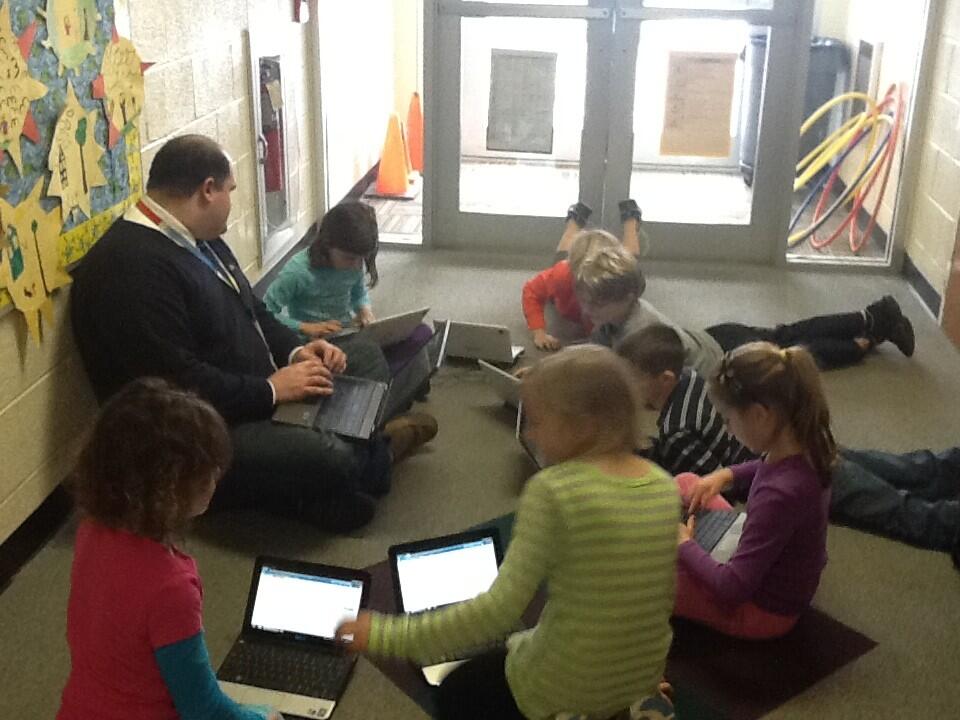
We have come to assume  that students will learn how to use the “stuff” pretty quickly. Just last week I supported some teachers who wanted to have their 2nd graders try their hand at blogging about an upcoming trip to the zoo.   I pulled a group of 8 students into the hallway and we sat on the floor exploring Kidblog together.  Before I could even begin to give them explicit directions, many of them had already figured out the wysiwig tools and were changing font colors, font size, and underlining text. This led to a great discussion about how and when to use those tools for effect in blogging.
When I asked the students how many of them had seen Kidblog before, none of their hands raised. When I asked them how many of them had ever seen the bold, or italic, or underline tool before, only 3 of them raised their hand.  I didn’t have to “teach” them how to make text bold, italic, and underline. I did need to help them explore why they might use those tools within their text.  Despite a relatively new environment, the students were willing to play. They weren’t worried about breaking anything, and they weren’t worried about failing miserably. They simply wanted to see what they could do with the tool.
As educators, we have a lot to learn from these second graders. We are sometimes given many “gifts” in the form of new hardware, software, curriculum materials, and even professional learning opportunities. And yet, for some of us, instead of opening those gifts up and playing with them, pushing them to their limits, and seeing what we can do with them, we often let them sit in a box (literally and/or metaphorically) until someone gives us the proper training on how it works. I’m not sure where we as adults lost our sense of play and our fearlessness.  I’m not sure when we became so complacent and unwilling to take learning into our own hands either.
We also need to recognize that the technologies our students might innately come to understand are not necessarily going to be used academically or appropriately out of the box either. We must also remember that not  all kids have the same experiences or access at home as they do at school.  In the end, our responsibility becomes less about learning how to make it work and more about how to make it work for learning.  


Friday, February 22, 2013

Choose Passion


When I read this excellent post by Angela Maiers (@angelamaeirs) about the passion gap recently, it helped me to reflect on how fortunate I have been to have some amazing mentors and teachers who have “metaphorically hugged me” by supporting and challenging me in support of my passions. (see @robinellis, @snbeach to name a few) I’ ve also had incredibly supportive colleagues and administrators as well. Sadly, I’ ve come to realize that my experiences are not typical in most schools or classrooms.

For many educators, William Butler Yeats’ classic quote “Education is not the filling of a pail, but the lighting of a fire.” resonates with them. Yet how often do we, as teachers, use the proverbial pail to douse and extinguish that fire inside of our students instead?  How often do we pour cold water on our colleagues ideas instead of fanning the flames? How often do administrators forcefully snuff out the innovative fires burning inside their teachers? How often do school boards or other state and federal bodies completely extinguish the fires inside the bellies of administrators who see the potential inside their schools and classrooms?

Based on that last paragraph, it would be safe to assume that “passion killing” starts at the top and  rolls down hill. In the accountability-based, standardized test driven world of education, what one does based on their passion is rarely appreciated or valued because it often can not be quantified or evaluated. Yet, those of us at the bottom of the educational  food chain, who often complain about a lack of professional autonomy and choice, professional development that doesn’t match our unique learning needs and styles, and little personalized feedback and support from our overworked principals turn around and return the favor within our classrooms.  We punish students by giving them little of their own autonomy or choice. We do not support their learning in personalized ways. And as overworked teachers we rarely give them the timely and necessary feedback needed to help them grow.

Many of us don’t want to admit this, but every one of us has a choice. Choosing to be passionate and providing that space for our students to be passionate learners is not easy in the current educational climate. It requires imagination and curiosity. It requires commitment and dedication. It requires data and evidence. It requires self awareness through reflection and adaptability to make necessary changes. It requires effort  and perseverance. It requires trust and faith. And most importantly, it requires courage. (See habitudes).

In all the rhetoric surrounding education reform these days, the words of Sir Ken Robinson always ring out to me:

“The fact is that given the challenges we face, education doesn't need to be reformed -- it needs to be transformed. The key to this transformation is not to standardize education, but to personalize it, to build achievement on discovering the individual talents of each child, to put students in an environment where they want to learn and where they can naturally discover their true passions.”


As educators, we must love our students and one another enough to embrace this vision and work tirelessly to make it a reality for every child. We must create classroom and district  cultures and climates that embrace inquiry and authentic opportunities of learning. We must be reflective enough to see the many ways we destroy our students and colleagues passions and then have the courage to change those practices.  We must shine a light on and reject the systemic processes  that do the same and work vigorously, professionally, and passionately to change them. And we must do this together. Living in a world with a passion gap is not acceptable for us or for our kids. We all have a choice. Choose passion.