Wednesday, January 28, 2015

A growing sadness

      My son Justin is 10 months old. He has entered into a phase where he would much rather be playing than be held. He is active and happy and wants to explore the world around him as much as possible. He is crawling, inch worming, and rolling depending on how motivated he is to get someplace fast (like chasing after the dog). He is extremely responsive to music and loves Mickey Mouse. Justin loves to play with a variety of toys and when we lay him down on the floor, he just goes off in various directions. On any given day, he moves from his toy farm animals to his multicolored rings, from the multitude of learning devices with lights and sounds and songs to his stuffed animals. He plays longer now, sometimes rolling around for over an hour. He expresses excitement with squeals and squeaks and the occasional “mama”. When he gets bored with one toy, he moves on to the next. He is constantly trying new things. He figured out how to get the little people out of the barn and put them back in. I don’t know why this amazes me, but it does. 


Watching him learn and grow brings us so much joy and with each passing day, I am reminded of how “simple” learning can be.

  • It is questioning. (Why can’t I fit this big orange ring into my mouth?) 
  • It is trial and error. (Maybe I can fit this big orange ring into my mouth if I turn it this way.) 
  • It is choice. (Maybe I will play with the little red ring instead of this bigger orange one for now.) 
  • It is perseverance and grit. (If I keep trying to fit this orange ring in my mouth for the next 20 minutes, it will eventually fit in there.) 
  • It is fun. (I am going to scream and laugh and giggle at this big orange ring as I play with it.) 


       While I enjoy this time with Justin, trying to appreciate every moment of learning , there is a growing sadness developing in my heart. It is the realization that while I am busy trying to appreciate every moment of learning and growth, he probably should be doing the same. The sadness is growing inside me because I know that learning in school will most likely never be more personal and more authentic than it is right now. In 5 years he is going to walk into a kindergarten classroom that is going to be driven more by ensuring that all students can read on grade level than by focusing on play. In 8 years, he is going to walk into a classroom that is more driven by being “college and career ready” (in third grade!) than by helping him see joy in learning. In 11 years, he is going to walk into middle school classrooms built around archaic curriculum instead of lively students. In 14 years, he will walk into high school classrooms that are entirely focused on content and the person in the front of the room, instead of the students (and the multitude of questions they have) in it.

      My growing sadness is built around the fact that our modern schools are places built around content and teaching instead of students and learning. I want him to perceive history as something to actively research and explore through his own questions. I want him to learn to think like a historian or an archaeologist. I want him to learn that mathematics is as much a language as it is a process and that the journey of arriving at a correct answer is as important as the final solution. I want him to learn to think like a mathematician or statistician. I want him to learn science through inquiry, through experimentation, by doing science, by developing his own questions and exploring them more deeply. I want him to learn to think like a chemist or an engineer. I want him to love reading and to express himself in a variety of ways. I want him to love music, art, theater, and sports. I want him to be creative and collaborative. I want him to seamlessly utilize technology to research, create, and connect with other students and experts and to amplify his learning. Most importantly, I want him to recognize that each moment is an opportunity to learn and grow.

Permit my cynicism, but schools like this don’t exist in many places (although there are places like this and in the video below.)


 If we were truly honest about our nostalgia for school, (also see “Why School”) we would admit that our beliefs about our modern schools and classrooms are entrenched in a reality that was never as good as we think it was. Think deeply about your schooling experiences. How often were you given choices? How often were you afforded the opportunity to control your own learning? How often were you afforded the right to explore what you wanted, in ways that you wanted, and show what you learned in ways you designed?  If you arrived at the “Look, I made it through school and I’m a successful adult.” or “School was awful for me, but it’s just a rite of passage my kids will have to deal with.” you might be part of the problem.

As an educator, it is incredibly easy to point fingers at: 
  • elected officials: for creating the test-focused climate.
  • media,elected officials, and administrators: who use the testing results in ways they were never intended to be used.
  • curriculum writers and coordinators: who purchase or create curriculum that we as teachers had no say in developing or vetting. 
  • building principals: who place too many kids in a class or place too many of “those kids” in our classes. 
  • parents: who did not prepare their student for school or do not engage with their students about their learning. 
  • students: for not taking the opportunity to learn nearly seriously enough.
  • other educators: who simply are not cutting it or "did not do a good job teaching the year before."

What’s not so easy, is recognizing that we as educators must: 

     As a parent, I promise that Justin will walk into a Kindergarten classroom with eyes wide open, full of wonder. He will be willing to play and experiment. He will be full of energy. We will work hard to make sure he knows his shapes, and numbers, and can read to the best of his ability. We will spend time helping him to learn to share and play well with others. We will do our best to help him to love and show compassion and kindness. We will spend the next 5 years preparing him to be a learner first, a student second. We hope that he will be met by a teacher with the same learning first mindset we are trying to instill.

     Right now there are many students in each class, just like Justin, staring at us, waiting for us to make the next move. Each student is not the same. They are each unique and deserving not only of our very best, but the opportunity to be the architects of their own learning. We need to stop playing the game of school. These are students who deserve to be learners first and students second. These are students whose future “nostalgia” for school could be based on the reality that school was a place where they did purposeful work for authentic reasons. A place where they created instead of consumed. A place where it mattered less what they knew, and more what they did with that knowledge. A place that honored creativity and perseverance more than grades. A place that personalized learning while also affording opportunities for true collaborative problem solving. A place that put their own individual learning needs ahead of everything else. 


(Sir Ken Robinson nails it in this Ted Talk from April 2013)


Monday, September 15, 2014

College and Career Readiness May Not Mean What We Think It Means.

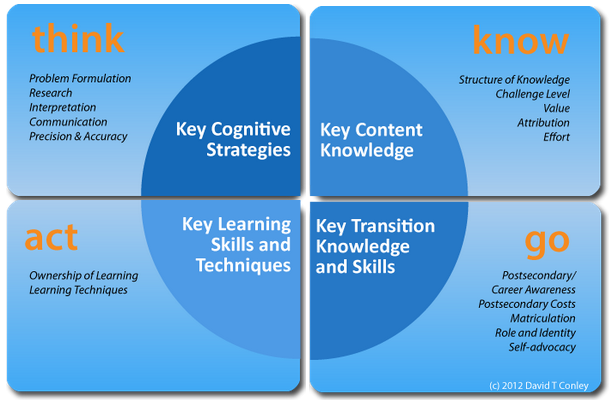
In the desire to help our nation’s kids become College and Career Ready we must consider that our assumptions about what that means ( and how to get there) may lead us to have the opposite effect of what is intended.  David Conley, a leading advocate for college and career readiness, already warns us about limiting the scope or definition of college and career readiness.  This also leads me to ask the question “Should the primary goal of a classroom teacher be to prepare their students for college? For a career? For the next year in their schooling?” Perhaps it’s semantic but isn’t preparedness a byproduct of learning?  Isn’t achievement (by whatever metric you choose to use) the byproduct of maximizing the learning potential of our students?
When we dig deeper into Conley’s definition and expectations of college and career readiness, we need to not only recognize, but embrace the seismic shift that occurred between our own schooling experience and the world our students are going to be entering into themselves. This is not to say that we weren’t prepared for the world or that our teachers weren’t very good. It’s just that the world of college and work are completely different from the ones we experienced upon graduation.


When we look at the diagram above, we must be willing to reflectively and honestly assess how much of our curriculum and instructional/assessment practices embrace all four quadrants.  Where do you see yourself philosophically? Pedagogically? What do you value? What kind of culture is being created by the choices you are making?  

Maybe this is an unfair generalization, but most secondary classrooms continue to  primarily focus on what students “know”.  The most well publicized metrics by which we currently evaluate student success  (and are now being used to evaluate our effectiveness as teachers), state standardized tests and national exams like the SAT’s, mostly measure what our students “know”. There have been attempts to move assessment measures into the “think” realm as well. But these are often difficult to write or take too long to assess with validity.  We can tell what these classrooms look and feel like because they typically involve a teacher front and center talking at students or burying kids in content without intentional instructional practices. These teachers don’t typically formatively assess and therefore can’t let classroom data  drive instruction. They don’t typically respond to student needs because they aren’t aware of them. They believe that their job is to help kids “know” stuff. And if after the test, the kids didn’t learn the stuff, it’s because the student didn’t study hard enough.

Better teachers recognize that what students “know” only matters in the context of  how they “think” about what they know. Fewer classrooms embrace the mindset that focuses more on what students do with what they know and have learned. These teachers recognize that multiple choice questions have their place, but mostly in quick checks for understanding. Teachers who aspire to have their students “show what they know” believe in performance, authenticity of assessment, and multiple and diverse  measures of success (and achievement). They also recognize that the more they talk at students, the less likely that students will have the opportunity to share their learning or what they “think”. These teachers believe:


BudLx5UIQAEz667.jpg:large


In 1778, Baron Von Steuben was given the task of whipping the ragtag Continental Army into shape. He is credited with being the father of the American military because he skillfully organized the troops through building common knowledge and instilling discipline  into the men at Valley Forge.  About the difference between European and American soldiers he is quoted as saying:  “You say to your soldier, 'Do this' and he does it. But I am obliged to say to the American, 'This is why you ought to do this' and then he does it.”

Great teachers recognize that students need to be aware of context and relevance.They understand that it is as important for students to connect the content knowledge and the thinking skills to their own personal lives. These teachers challenge students to ask “Why does this matter?” or “Why should this matter to me?”  Teachers who do this conference with their students frequently and discuss content and skills in a greater context beyond academia. These teachers encourage students to explore personal interests and make connections to the curriculum and skills in the classroom and beyond.  Teachers who do this make metacognition and  student reflection a key element of their classroom design. These teachers intentionally develop a culture for students to truly be independent learners and encourage them to reflect on their goals.  In these classrooms, students make  connections between what they know, how they show it, and where they plan to “go”  when they leave their schooling behind.  

The best teachers understand that no matter what curriculum we implement, no matter what instructional and assessment practices we utilize, students can not be college and career ready if they are not the architects of their own learning.  Teachers do this by providing students authentic and meaningful choices such as which learning strategies and processes they will employ, the way in which they choose to access the  content, and how they wish to prove their learning. These teachers not only encourage students to develop their own questions, but they actively teach students how to do this better AND provide the necessary  time and feedback to become great at it.   A classroom in which the teacher and students are co-learning and collaborating together is evidence that not only is the classroom student-centered, but also student-driven. This does not mean the classroom is a free for all either. These teachers have very clear expectations of learning, are standards aligned, and provide scaffolded support too.

I’m not entirely sure what it means to be “college and career ready” yet, but I do know a few things it is not. It is not:

  • lecturing “because it’s what they do in college” (lecturing has its place but not as the primary method    of instruction or without frequent discussions and checks for understanding)
  • giving large final exams or midterms “because it’s what they do in college” (What do these types of assessments tell us about our teaching and student learning? )
  • giving lots of homework because we need to teach kids “responsibility”
(Responsibility is about doing whatever it takes to learn, not nightly assignments that have inappropriate 
cognitive demand for most learners.).
  • forcing kids into rigid coursework in the name of rigor and high standards (By all means we should afford students choice of coursework but a high level course does not guarantee high quality of learning. Rigor is about the individual students, not the course)
  • creating prescribed pathways and programs for all students (A one size fits all pathway doesn’t honor the individual needs and choices that being an independent and college and career ready learner demand)

Ultimately, if we want students to be successful  and productive adults, we need to help them to become the best learners they can be, not the best students (and there is a big difference between the two). We need to embrace the challenge that college and career readiness is going to require a different pathway for each student. We need to acknowledge that this goal is an ever-evolving and moving target as our definition of college and career readiness might already be irrelevant by tomorrow, let alone 4 years from now.  If we want our students to be college and career ready, we need schooling to be less like “school” and more like the real world. We need to afford our students the same autonomy (with support) that we as adult learners rightfully demand.  We need to ensure that our daily classroom practices and district wide processes don’t unintentionally widen the expanding gap between preparing our students for a world we can’t envision and holding onto a past that no longer exists.  

Wednesday, March 12, 2014

Seeking Connections

One of the polarizing arguments about technology use today is whether technology creates human connection or replaces it.  On one side of the fence sits the twitterverse, where social media creates foundational relationships built on a constant stream of 140 characters. This side of the fence is where facebook status updates and instagrammed images help weave the stories of our lives and interconnect one another in ways that were not humanly possible ten years ago. On the other side of the fence sit those who believe that all of the technology and gadgets are creating a divide between the real and digital world. Those who sit there believe that nothing can replace the human experience, lived face to face, one conversation at a time. Let’s also acknowledge that there are plenty of fence sitters as well.  In education circles, the argument is one in which the idea of MOOC’s, self-paced learning management systems, and learning on demand terrifies, excites, or leaves you with the question “What’s a MOOC?”  The cheers of teachers who welcome the evolving role of educator are being met by the cries of those afraid that they are being outsourced by devices and software.
As a classroom teacher, what mattered most to me was relationships with kids.  It’s what I miss most about my current role as an instructional coach. And although I have forged some incredible working relationship with colleagues, it’s a different animal altogether. Building relationships with kids is hard but rewarding work.  It’s why teachers meet their kids at the door and greet them as they enter the classroom. It’s why they are willing to help them over lunch or before and after school. It’s also why we grin from ear to ear when we see our students stretch and grow.  Building relationships with students benefit us in a million little ways that add up to major gains. Classroom management, true academic stretching, commitment to the school and greater community are all impacted positively by getting to know kids really well.
One of the greatest lessons I ever learned as a middle school teacher was that in order for me to build these meaningful relationships with my students, I could not teach the same way I had been taught or had been teaching for the first few years of my career.  Teaching from the front of the room did not afford me the time to conference with students. Reading from a textbook and leading whole group discussions did not afford me the chance to connect often enough to make a real difference in the lives of each student.  I was realizing that the opportunities that gave me the most one on one time with students were the experiential learning activities. It was in small group situations. And eventually, it was when students were personally interacting with devices to question, research, and create.   It was in these small one on one interactions where I could clarify, push, support, challenge, and celebrate safely with each student.
The technology also afforded different opportunities to personalize communication. Providing feedback and comments through google docs. Clarifying questions through instant messaging. Sharing of assignments and reminders through a texting service like Remind101.  Creating student portfolios of growth and learning through google sites and blackboard.  Maintaining a class wiki to share exemplary work with the world. Students reflecting through personal blogging. The tools themselves did not build, strengthen, and maintain the relationships. But the use of them provided time to foster them more fully.
Believing in face to face relationships and supporting technology are not opposing perspectives. Just as it is ok for us to continuously use social media to connect, communicate, and learn, we must also learn (and teach our students ) to put the device aside and interact more fully and in the present with one another. This also needs to be modeled in our classrooms with our students. We need to put the devices aside whenever possible. We need to close our mouths and open our hearts and ears to our students. We need to continually let them know they matter.  Seeking connection to one another is as human as it gets. Using technology to enhance human connection is not wrong.  It should never be about the device or tool. It is always about the ways in which we use the tools to learn, grow, and connect.

Wednesday, February 12, 2014

What does your reflection say about you?

On the first day of every school year, one of the class procedures and promises I made to my students was that there was nothing I would ask of them that I haven’t already done or would not be willing to do. We discussed how important my role as a learner was in the classroom and that while I (for the most part) had more content knowledge and skill as a teacher, my job was to learn about each and every one of them, as well as learn alongside them. I explained that there were times we would try out a new web based tool or use a device that I was not 100% familiar with and that we would be on an equal playing field. There were many times they taught me quite a bit about the tools too. They loved to show off and teach me.  My job was to develop a worthwhile academic purpose for using the tool, even without being an expert on it. There were also times where I was asked to play a bear or a tree or any number of inanimate objects in class skits or presentations. My students hopefully understood that I believed that we were in it together and that I meant what I said about learning and trying new things together.
Before I go and pat myself on the back, it also makes me realize just how many times I did NOT practice what I preached. One of my favorite statements is that we as educators often hold our students to a higher standard than we hold ourselves.  Want proof? Ask yourself about how often you emulate the following “habitudes” in your personal life? What about in your professional life? How often do I...
  • ... imagine or wonder?
  • … use my imagination and creativity to solve problems?
  • … allow my curiosity to drive me?
  • … allow myself time to explore or question or follow my curiosity?
  • … reflect?
  • … make changes based upon those reflections?
  • …  seek out challenging or difficult situations?
  • … stick to it, no matter how difficult or challenging it may be?
  • … rise to a challenge presented by others, even when it goes against your current      belief system?
  • … commit to patience
  • … commit to hard work without complaint?
  • … learn from my mistakes?
  • … rise when I fall?
  • … seek to understand the why before the what and the how?
  • … reflect on what success means?
  • … put myself in my students’ shoes?
  • … put myself in my colleagues’ shoes?
  • …. in my administrator or bosses’ shoes?
  • … set goals and evaluate my success on the goals with data?
  • … reflect on what is my opinion and what is validated by research and information?
  • … support my beliefs and opinions with facts and citing evidence from research?
  • … listen to ideas and opinions that are different than your own without judgment?
  • … kept a positive attitude in the face of criticism or a difficult situation?
  • … reflect prior to reacting?
  • … recognize the changes that were occurring around me whether I liked it or not?
  • … share my passions and interest visibly with others?
  • … bring energy into my experiences with others?
  • … exude confidence and promote confidence in others?
  • … model flexibility?

When we hold up the mirror to ourselves, we need to ask ourselves if we are living up to the standards we set before our students?  When we ask them to do hours of homework each night, are we committing to spending our own time away from the classroom, providing them meaningful and timely feedback to promote growth and learning? When we ask our students to care about our content and our classroom and to engage with new information and try new skills despite fear of failure,  we must ask ourselves how we ourselves feel about new learning and experiencing failure. What is our reaction to information shared by colleagues, at faculty meetings, by district professional development?  When we ask our students to work in small groups, to engage in collaborative learning, we should be examining our own attitudes about working with others and collaborating with colleagues. How can we reject working with others, while demanding it of our students?
If we want our students to be engaged, to be creative, to be caring, to show perseverance, to adapt, to be imaginative, to collaborate well, to ask deep and meaningful questions, to be confident, to reflect, to be honest, to be courageous, and to love learning, then we must believe these virtues and live these habitudes.  As educators, we rightfully expect so much of our students and we must demand the same of ourselves..  When I look out at my students, I want them to be a reflection of all of those demands and expectations. I also acknowledge that ultimately, they, are a reflection of me.  When you look out at your students, what does their reflection say about you?

Wednesday, January 15, 2014

Unnecessary and replaceable.

“A teacher is one who makes himself progressively unnecessary.” - Thomas Carruthers

“Any teacher that can be replaced by a computer probably should be.”- David Thornburg


Both of these quotes came across my twitter feed this week. At first glance, these seem to be conflicting goals. How does one make himself “progressively unnecessary” while NOT working himself out of a job (or being replaced by a machine?)  However, these two statements speak to a growing tension that today’s educators are becoming more acutely aware of, even if they can’t quite describe it.

Operating under the assumption that the goal of all teachers and educational systems is to challenge students to become independent thinkers and learners and to apply necessary working and life skills without the support of another,  the Carruthers quote makes a ton of sense philosophically. However, the idealism of “guide on the side” is often not realized in many classrooms. The “sage on the stage”  model is comfortable, convenient, and requires compliance from the student (not the independent thinking we claim to value). It requires little daily instructional change and promotes passivity for both teacher and student.  This pedagogy (and the inherent instructional and assessment practices) is what many educators experienced (persevered through?) and succeeded in throughout their own schooling.  Asking ourselves to reject a system in which we found success is a daunting challenge. However, this mindset, where the teacher is disseminator of all knowledge, represents a need for control and maintaining comfortability at all costs. It also flies in the face of the established goal of helping all of our students to truly become independent learners.  It is believing that our students can not learn without us.

Thornburg’s quote speaks to a different fear many teachers are realizing when they look out at their students. These students are becoming increasingly disinterested in traditional schooling and prefer to engage with peers and content online. We often make the mistake of assuming that they aren’t learning when using these devices or engaging online. We then begin to believe that schools should be places where we must “slow down” the learning. They become places where we must disconnect from the outside world. Classrooms become places where students must master the most basic content and skills before ever being allowed to move into higher-level, critical, and creative thinking.  The birth of cyber charters, self-paced content delivery, and good old fashioned “surfin’ the web” are scaring the heck out of teachers because it means that they no longer control the flow (or accuracy) of information. It also proves that our students CAN learn (and are) without us.

We can either continue to be terrified by this, or we can rise to the challenge and realize the potential opportunity that embracing technology affords us. It doesn’t replace us, it asks us to envision a classroom much different than the one we experienced. It asks us to allow our students to take control of their learning.  It asks us to provide more opportunities for students to be independent learners. It liberates us from having to know it all or be able to do it all. It asks us to rethink our roles as educators. It demands we think more about questions and less about answers.   This kind of thinking is device agnostic and in many ways, doesn’t require a device at all. “Technology” is shaping the world around us in ways we can’t possibly yet comprehend and denying the impact on our students and classroom is akin to burying our heads in the sand.

Many of us have not accepted that much of what we value and believe about teaching has already been replaced by technology. Holding on to the belief that we lose value because we no longer disseminate all of the information is detrimental. Tightly gripping the mantra “Hey, I taught it therefore it’s their responsibility to know it” is downright damning. Once we accept that our roles must change,  what will remain are our steadfast beliefs about learning and the unquenchable desire to see our students become successful and independent learners. Every educator (and parent) has had that moment. It’s the one where the toddler is able to take a few steps on their own. It’s the one where the child is able to write a sentence by themselves. It’s the one where the teenager says “Hey, I got this. Let me do it by myself.”  In these moments,  we should beam with pride knowing that we have made ourselves progressively unnecessary. It is also in these moments we should recognize that by putting their needs above our own, we have truly made ourselves irreplaceable.

Tuesday, December 17, 2013

Technology as an amplifier.

When we think about the potential "technology" has to transform classrooms, there is no shortage of cliche's or 140 character "truths" that can be uttered in a moments notice. And it's not that I don't believe in many of these ideas or that our students do not deserve to learn using whatever tools help them learn best.  Over the years, one of the statements that has always resonated with me is the idea that "technology is an amplifier".  At face value, this may sound like a truly underwhelming vision of what "technology" can be in the hands of the right teachers and students. My initial thought about this statement years ago was that it didn't go far enough in shining a light on the potential "technology" has to offer in our classrooms and schools.

Yet here I sit several years later and upon further review, I think this statement is spot on.  That's not to say that the uses of "technology" in a classroom can't be transformative. It's just that often the "technology" we use shines a light on the wrong things. In some cases, it amplifies bad practices too. Which is why I think we have to be careful that we aren't being hyperbolic when discussing the power of technology to the technophobes and cynics when heavily investing in "technology" in schools. We have to accept that no amount of new devices or access to new software or tools will ever increase learning. Period.

What  does increase learning is the effort and will of the person(s) behind the design of the learning opportunities and experiences for our kids. (ie. the teacher)

Five years ago when I began to heavily invest in teaching and learning about technology in my classroom (mostly through my online PLN), it became obvious to me that I was a hypocrite. The very things I was spouting  to complete strangers and preaching  to colleagues  were not evident in my classroom. And maybe my colleagues were just patient because no one called me out on it. But it was true.  And that burden weighed heavily on me.  All of the technology I was using in my classroom was "amplifying" poor instructional and assessment practices. Having students re-create "digital" poster projects was not innovative. Disregarding curriculum in order to do projects that interested me and had little academic purpose other than to say we were learning "online" only benefited some of my students.  I'm not too proud to admit that I had wasted kids time by giving them way too many days to "research" just so I could say we were using online resources. The truth is that I loved the idea of doing all of these amazing "projects" I kept reading about, but I just didn't want to put the time or energy into ensuring that the "technology" was being used effectively, efficiently, and maximizing the learning potential for ALL students.  I did not want to collect and use evidence that might prove that I had absolutely no clue.

I didn't want to explore standards. I didn't want to determine the essential questions or enduring understandings. I didn't want to write student friendly objectives or have my kids reflect on them. I couldn't even begin to determine how to best assess my students because I hadn't even identified what was most essential to begin with. I was wandering the desert. And I suspect that many of my colleagues are stuck there right now too.

Perhaps to be fair, jumping from web based project to web based project led me to designing a project based unit which led to designing a few others.  I began to study the standards and grapple with essential questions. I began to explore transfer skills and determine what content was essential. I began to map out my assessments methodically and strategically and I was rarely surprised by the results I achieved (good or bad). I stopped hiding from the data and other evidence and each assessment provided an opportunity for me to challenge myself. It became as much about my growth as my students.

I have hope that many of my colleagues who are engaging in web based collaborative learning are moving towards the panacea of authentic, student led personalized learning too.  The potential to learn together, collaboratively and beyond our physical location is too great to pass up. But so is the potential of designing truly meaningful, authentic, standards driven (there, I said it) learning experiences that don't ignore the classic literature or seminal moments of mankind's history. We can't forsake exploring essential content or grappling with integral skills just so we can have our students use the latest web based tools.  We can't simply trade the textbook for a laptop and expect our kids to become expert learners.  At the end of the day, technology is an amplifier. The question we must all ask ourselves is "What exactly is it amplifying?"

Wednesday, November 20, 2013

Technology is not a magic bullet.


A few days ago, I had the opportunity to check out the newest exhibit  “One Day at Pompeii” at the Franklin Institute in Philadelphia. Aside from how well the Franklin treats educators on these “educator’s night out”, it was easy to be blown away by the technological advances the Romans had developed. Perhaps it’s just my lens, but I’ve always appreciated just how inventive the Romans were. From using terra cotta pots under floor boards to amplify sound in theaters to developing medical devices that are eerily similar in shape and function today. From  utilizing radiant heat to heat floors and walls to designing hydraulic metal gauges to alter water pressure through city pipes, the Romans were adept at evolving and changing technologically, to make their lives better and easier.  These advances also led to economic collapse and caste systems, and an ever expanding empire that could not sustain itself. When the Roman Empire disappeared, so did many of these advances (at least for a few hundred years). 

I also spent part of this past week reading an article in the New Yorker about the elusive self driving car. I found myself reflecting on the role that technology plays in our lives today. The idea of the self-driving car has essentially existed since the dawn of cars themselves. And in the age of technology driven distracted driving, it’s an idea whose time may have come. The irony is that the more that cell phone technology and mobile computing penetrates our lives, the more likely it is that we as humanity, will use it inappropriately. Our vehicles are becoming so technology rich that the basic function of driving has at times, taken a back seat (pun intended) to the navigation, entertainment, and communication options that are present.  I don’t mean to sound like an old fuddy-duddy, because if I’m being honest, the technology options are what draws me to certain vehicles.  The point I am trying to make is that the technology itself is not bad or evil, it’s how we use the technology that determines its effectiveness.


So what does this have to do with  teaching and learning?  
Technology in classrooms is not a magic bullet.


We are beginning to see entire city school districts jump on the iPad and tablet craze. We are seeing more and more schools go 1:1 with laptop initiatives. We are seeing a proliferation of BYOD policies pop up.  And unto themselves, these are hugely popular for students and are steps in the right direction. But as Lee Corso would say, “not so fast my friend”. Professional development for administrators and educators often focuses on the “how does it work” as opposed to how should we use this to help students make meaning, communicate, collaborate, and create?  Many unfairly assume that educators are chomping at the bit to design instructional learning experiences using technology.  This is true in some cases.  In other cases, laptops are used as paperweights at worst, and for word processing at best. Tablets are used for games and low level practice skill and drill. A teacher who focuses on memorization and low level thinking skills will not all of a sudden change their stripes when handed a new device.  


At its core, those who see the transformative potential of technology rich environments understand that it is not the technology itself we need to begin with.  It is the hearts and minds of our colleagues whom we need to help envision what their classrooms and schools could be like.  It’s about having many deep and personal conversations with colleagues around the kinds of learning experiences they wish for their students to be engaging in. It is about us nudging them and their students towards an even greater potential. It’s about coming alongside those educators and modeling and teaching and re-teaching and revising and reworking. It’s about designing units backwards together. It’s about debating  the essential questions and enduring understandings.  It’s about unpacking the standards and the skills. It’s about designing assessments that matter and making it all relevant to each individual student.  

I will admit that I am as much at fault here as anyone. When I speak about technology to my peers, it is often through the lens of efficiency (If you use this tool, it will grade all 500 of your essays FOR you!!!) . It is also often through the lens of a “cool factor”  (Check out this amazing new tool that allows you to share this youtube video in 100 million different ways and solve world peace at the same time).  And it’s not that those things don’t matter or shouldn’t be shared. They are entry points. But the truth is, like all things in life worth doing, there is no secret to making technology transform a classroom or school. Nothing will replace conversation after conversation. Connection after Connection. Nothing will replace the relationships built over time. And ultimately, building a technology rich learning environment takes sustained effort.


It is not a magic bullet.

(Albert Einstein and Thomas Edison knew it too)