Monday, February 22, 2016

What if we stopped complaining and started doing?

I had an opportunity to meet and speak with someone whom I have long admired today. George Couros writes and reflectively shares his thoughts on leadership and learning on his blog, through social media  (@gcouros) and in his book  "The Innovator's Mindset: Empower Learning, Unleash Talent, and Lead a Culture of Creativity". What I have often admired about George is that he writes and speaks practically, openly and honestly. He blogs often. He makes time to reflect and he makes time to lead through building relationships.

It's been awhile since I have attended an ed-tech conference for a multitude of reasons, but chief among them is what I have perceived as the increased "self-promotion" of individuals and the exploding capitalism of learning by ed tech companies. Around every corner, there is always a person or product willing to take your money and solve your problems for you. There is also no shortage of people who will showcase how amazing and transformative something is without actually being able to provide evidence of the impact on student learning.   This is also one of the reasons why I have shied away from the use of social media altogether in recent months.

Meeting George face to face actually gave me a sense of guilt and shame because he is one of those people who I believe actually walks the talk. My shame stems from the fact that I often don't make the time to write and reflect. My guilt stems from the fact that I don't participate and share the way I believe we all have an obligation to do. Sadly, I spent most of the early parts of our conversation complaining about lots of things instead of engaging in meaningful conversation.  As I became aware of my overt negativity, we chuckled and George even commented that I should change my twitter handle to @bitchychad. ( I looked it up and no one has used it yet. Maybe we can get it trending.) But in that moment, I also realized how much time and energy I have wasted complaining instead of doing.  Even in a moment such as this, instead of focusing on potential, instead of learning about how to be the change, instead of learning from someone with expertise, I was fixated on sharing my frustrations. I can't say it was one of my prouder moments.

This realization has implications on my perceptions of social media and conferences. When we only see the negative, when we only see the problems, we miss the beauty and the opportunities all around us. I often think of a white sheet of paper with a tiny black dot in the middle of it. How often do we focus on the black dot instead of the vast, white, clean paper ready to be transformed?   How often do we only see the negative in our classrooms, schools, or communities? How much time do we spend focusing on the problems instead of celebrating and working at the opportunities in front of us?

And if I am being truly open and honest, I think it's how many of us waste a lot of our time and energies. We consistently kick the can down the alley: blaming others, blaming our circumstances, and blaming the system.  There is no doubt that there are hurdles to overcome. There is no doubt that there are systems in place that make it challenging. But they aren't impossible circumstances to overcome and the hurdles aren't impossibly high to get over. We have to stop admiring the problems. For some of us, it would mean we might have to admit that we aren't good enough yet. For others, we would have to acknowledge that it is going to take a lot of work to get to where we want to be. And for others still, it would mean looking deeply at why we are avoiding moving forward.

Tomorrow, I am excited that George will keynote #petec2016 and spend some time sharing many of his thoughts, ideas, and perspectives on leading and learning in funny, engaging, and provocative ways. And I will listen, not focused on what can't or won't happen, but by recognizing that there is potential for every student, every teacher, every administrator, every board member, and every parent and community member to do amazing things for our schools and our community.  I hope to get him to sign his book for me, even if he does sign it  "for @bitchychad".

What would we gain if we stopped complaining and just started doing together? 


Friday, October 2, 2015

What if we remembered what it was like to be new?

One of the opportunities we have been afforded in our current roles as instructional coaches is to support new teachers to our district.Our current induction process involves a week long "New Teacher Academy" and then a series of face to face meetings throughout the year. We are also using a district wide LMS to build community between meetings through discussions and sharing.  The make-up of this years group is diverse in experience. We have teachers who are in their first year as a teacher and fresh out of college. We have teachers who are in their second career. We have teachers who are returning to the profession after spending time at home with their family. And we have teachers who have come from other districts in search of new opportunities.

The start of the year can be an extremely difficult and challenging time for a veteran teacher, let alone someone who is trying to establish their role in the culture of a school or district as a newbie. Learning new curriculum, new technology, and building new relationships is challenging. Fitting into an established culture, following through on expectations, and navigating the politics of a school or district is completely overwhelming.  Even under the best circumstances it can lead to many more questions and self doubt than answers and confidence. Many new teachers find support with one another and with grade level or course alike partners and collaborators. Sometimes they are supported by district provided mentors or coaches, and if they are fortunate enough: a building principal willing to invest in them.

A recent meeting with our current crop of new teachers forced some much needed reflection and contemplation. While there were stories of small victories (I finally got logged into this system!) , celebrations of established routines (My kids actually lined up properly after two weeks of practice!!), there were also stories that brought tears and sadness. Sometimes these stories are things we can do little to control. How do we support a teacher when a parent chooses to use Back to School night and social media to openly criticize them despite trying their best.  What can we do differently when students openly mention that they can't wait for the 'regular' teacher to come back?

But what about the things we have control over? Is moaning and groaning about a colleague who pushes into our classroom with a cart to teach, a proper way to treat them just because we can’t use our space for our prep work?  Is it acceptable for us to tell a new teacher in our building that we don't have time to show them where the photocopier is or help them navigate curricular resources? Is it right for us to ignore a new teacher in the faculty room or not say hello in the hallway?  Is it kind or compassionate to openly criticize how a new teacher is running their classroom or teaching?  
We often worry about about our students and the way they treat others. My earliest recollections of school involve learning the golden rule. The truth is that we make our jobs infinitely more difficult because instead of supporting one another it’s much easier to tear each other down. Is it time for us to look in the mirror and acknowledge that sometimes we don't practice what we preach? That sometimes we forget what it is like to be new.

What if we stopped to ask a new teacher in our building to sit with us at lunch? What if we stopped into the classroom of a new teacher and asked how things were going? What if we stopped them in the hallway and asked them if they needed help with anything?  What if we sent a new teacher a note or an email telling them how happy we were to have them in our building? What if we took three seconds out of our day to tell a new teacher that we were excited to learn alongside them? What if we took time each day to remember that  teaching is much more enjoyable when we support one another? What if we committed to 30 minutes a week sharing and collaborating? What if we remembered what it was like to be new?

At the end of our last meeting we asked each member of the group to write down something that they were proud of on a post it note. We asked them to fold it up and put it in their wallet or purse.  And we asked that the next time they felt beaten down, found themselves crying or wanting to quit, that they should get out that note to remind them that there are many things to be proud of. While what I write next wouldn’t fit on a post it note, I do want to share what I am proud of.

So to our new teachers (and new teachers everywhere):

I am proud of you. You wake up every day and come to school with the best of intentions: to help students learn and to grow. You put up with the nonsense and the noise. You put your best foot forward. You work through the tears, the criticism,  the long nights, the loneliness, and the feeling that what you do will never be good enough. You recognize that this profession is not what you expected it to be. You question whether you will make it to December, let alone to the end of the year. You wonder when it will be fun. And yet each day you treat it like it is new again. I am proud of you because you understand grit, perseverance, and problem solving because you know no other way.  I am proud of you because you choose to continue to learn and grow and approach each task as a new opportunity to improve.

It’s ok to recognize the negative, the hurt, and the frustration: but remember this moment. Remember that this is the moment you acknowledged that despite it all, it is completely worth it.  Remember what it feels like to be new. Remember that our students walk into "new" at the start of each year. Remember that next year, there will be colleagues who will be experiencing what it means to be new. Remember that you pulled yourself up by the bootstraps. Remember that it got better (not necessarily easier). Remember that you found the support you needed. Remember that you learned what you needed to because you never stopped trying. Remember that you won over parents and students because of the kindness and compassion you showed them. Remember that you will never be the same teacher you are at this moment.  Remember that despite the heartache and challenge ahead of you each day, what you do is valued by many even though they may not say it or show it nearly enough.  Remember that to each student who walks through your door, you can be their support and their hero. What you do each day makes you my hero. Remember that we are proud of you.

Friday, September 25, 2015

What if... we are wrong about college and career readiness?

Many schools and school districts utilize metrics such as high school graduation rates and standardized test scores to determine their effectiveness. Focusing on state-wide assessments (here in PA it would be the PSSA and Keystone Graduation tests in Biology, Algebra 1, and Literature) as well as national assessments such as the ACT, SAT, and AP tests, provide insights into the strength and quality of an academic program. Some school districts will also explore the amount of students who go on to 4 year colleges, who remain in college after a year, and who actually graduate from a 4 year program.  All of these elements play a role in determining a student's college and career readiness as well as district success in developing students for the worlds of college and work. It is challenging to argue that preparing students for college and careers beyond traditional K-12 schooling is not the mission of school itself. Yet there are fundamental philosophical differences between those who believe the mission of school is to produce compliant, hard working, efficient members of the American workforce and those who believe the mission of school is to develop passionate learners. What if we are wrong about the data? What if we are wrong about career and college readiness?

Many have written about the need to shift away from the traditional factory models put in place in which students became the cogs of the American labor force. And yet many school systems continue to double down on the traditional pathways to success because they are unwilling to envision or implement (or both) non-traditional measures of success. Should school culture be considered when determining the success of a school or district? It's an oversimplification, but a recent conversation about school climate during the 2015 EduSummit drove home three simple questions "Is your school a place students want to come to? Is your school a place parents want to send their children? Is your school a place your employees/teachers want to work in?".  Where do these questions factor into the success of a school or district? And while we wouldn't want to solely determine the academic quality of our schools through these questions, who is willing to ask them, let alone care about them?  Do stakeholders really come to school, send their children to school, or work in a school based on a Career and College Readiness Index?

This is not to say that helping students to become successful students isn't one of the most important aspects of becoming effective learners, but I am saying that we consistently limit our expectations for students and what is in store for them because we only utilize measures that are both easy to measure and to predict. The most fascinating trend in education today is how often administrations rail against state mandated testing and the disruption is creates, yet they then administer equally  disruptive "diagnostic" tests to predict student success on those same assessments.  Let that sink in: we are now administering more standardized tests to help us predict and support student success on standardized tests we complain about them having to take in the first place.

We develop data teams and data plans around these same measures as well. We can't continue to blame lawmakers (and rightfully so) while hypocritically utilizing other tests that measure how well they might do on the tests we loathe. While we are at it, let's stop pretending that teachers should effectively and efficiently utilize these types of tests to design instruction and interventions. Meta-analysis by John Hattie and years of research by Dylan Wiliam et al overwhelmingly show us that formative assessment yields tremendous impact on student learning and growth, yet we keep distracting teachers by the big data of these tests.   Success on those metrics may make us feel better about ourselves systemically but they do not actually translate into an ounce of meaningful student learning.  Just google "does the SAT predict college success?" and you will find that there is not a strong correlation between the two. Recent trends are moving away from standardized tests as requirements for college admission as well.

“What makes the SAT bad is that it has nothing to do with what kids learn in high school. As a result, it creates a sort of shadow curriculum that furthers the goals of neither educators nor students.… The SAT has been sold as snake oil; it measured intelligence, verified high school GPA, and predicted college grades. In fact, it’s never done the first two at all, nor a particularly good job at the third.” Yet students who don’t test well or who aren’t particularly strong at the kind of reasoning the SAT assesses can find themselves making compromises on their collegiate futures—all because we’ve come to accept that intelligence comes with a number. This notion is pervasive, and it extends well beyond academia. Remember the bell‐shaped curve we discussed earlier? It presents itself every time I ask people how intelligent they think they are because we’ve come to define intelligence far too narrowly. We think we know the answer to the question, “How intelligent are you?” The real answer, though, is that the question itself is the wrong one to ask.” ― Ken RobinsonThe Element - How finding your passion changes everything

Certainly the mission to make students "career" ready can't be bad, right? Inherently, no. However, it is arrogant for us in education to believe we know what the world outside of school actually wants or needs when so little of what we do is actually like the "real world".


Schools and classrooms too often reflect that traditional vision of career readiness.  Are we as a profession prepared or capable of supporting our students for the world that lies outside our classroom?  Look at this research from a poll conducted in 2007 from the Association of American Colleges and Universities (which by today's standards is ancient history) of the top ten things employers want from college graduates:
  1. The ability to work well in teams—especially with people different from yourself
  2. An understanding of science and technology and how these subjects are used in real-world settings
  3. The ability to write and speak well
  4. The ability to think clearly about complex problems
  5. The ability to analyze a problem to develop workable solutions
  6. An understanding of global context in which work is now done
  7. The ability to be creative and innovative in solving problems
  8. The ability to apply knowledge and skills in new settings
  9. The ability to understand numbers and statistics
  10. A strong sense of ethics and integrity
Source: "How Should Colleges Prepare Students to Succeed in Today's Global Economy?" (Results of a national poll by Peter D. Hart Research Associates, 2007).

Do our classrooms teach and  measure these? Do our schools support teachers who want to help students to be successful in these skills?  Does the SAT, ACT, random state test, AP test, or any other standardized test measure more than one or two of these things?  Do they even measure them well? Explain to me again why we continue to think that college and career readiness is the goal if we are unwilling to accept that our vision of what that actually means,  as well as our measures of success are outdated and insufficient. If we truly believed the list above we would see classrooms that embraced Project/Problem/Passion Based Learning . We would embrace inter-disciplinary work. We would utilize the power of heterogenously grouped learning environments instead of creating caste systems of haves and have nots. We would personalize learning by supporting students in their own systems of inquiry.

No one will disagree that college will open many doors for students and that success on the SAT can provide students more options by helping them get into college, but should that really be THE goal for our students? No one will argue that one of the missions for schooling is to help them to be "career ready", but which careers?  We know that there is varying unscientific research on the amount of careers employees will have in a lifetime of work. We also  know that what they will need to know is less important than how they will need to learn and apply that learning.  There is also much debate about the oft repeated yet rarely substantiated "we are preparing students for jobs that have not been created yet".   Ultimately, we must acknowledge that technology is rapidly changing the demands of the work force (even if not the traditional labels of jobs) vastly. We also have to realize that app developer wasn't a thing 5 years ago.

College and career readiness should be something we care about, but it's a limiting mission quantified by even more limiting tests. What if the mission of school was to develop passionate, creative, and articulate learners? What if the vision was a workforce of people performing jobs and tasks based upon things they loved doing or felt called to do?
“Education is the system that’s supposed to develop our natural abilities and enable us to make our way in the world. Instead, it is stifling the individual talents and abilities of too many students and killing their motivation to learn. There’s a huge irony in the middle of all of this.” ― Ken RobinsonThe Element: How Finding Your Passion Changes Everything
What if we believed the purpose of education and schooling was to develop the abilities of all students to make their own path in the world? Would they then be college and career ready too?

Wednesday, September 9, 2015

What if?

For about three years now, I have had this magnet in front of me near my desk.


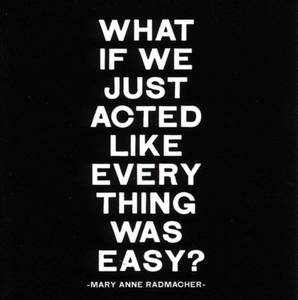
Many times I have stared at that magnet when I have been frustrated with things large and small. I often reflect that if we could all just take a pause, breathe, and recollect our thoughts, things weren't as hard as they seemed. Quite often I have heard the phrase "Teaching is hard" and there is no doubt that the teaching profession is incredibly difficult, complex, and challenging. Yet those words connote so much more than "Teaching is hard". While it's semantic, I believe it's important to represent that what we do as educators is complicated and rarely "easy" or "hard".

At the heart of the quote are two key elements: the question "What if" and the spirit of the quote, which is ultimately about mindset and attitude. Too many of us allow the walnut trees to dictate how we approach the constant array of complications and changes. The joke in every school building is often "wait a few years and it will go away". Sometimes, things go away in one year. But WHAT IF, we took each change, each implementation plan, each curricular change, each initiative and acted like it was easy. What if we looked for the useful,  the redeemable, and added it to our repertoire?


What if instead of fighting change we embraced it by looking for the good? What if we acted like it was easy?

The question "What if?" continues to resonate with me and I have decided that this school year, my reflections will be focused on that very question. At the heart of all learning are deep meaningful questions. What if... can be a powerful one.


As I began to wrap up this first blog post of 2015-2016, I became aware of the incredible story of two young girls from Washington state who designed and sent their own spacecraft into space. Take the 7 minutes to watch their story.


I am confident that their story began with a "What if?" I am confident that some educators would have told the young sisters that what they wanted to do was too "hard" for them.  Luckily for the world, these sisters acted like it was easy (I'm pretty sure it wasn't).

"These two sisters set out to make something fun and exciting, and they certainly accomplished that. What they might not know is that they also created something beautiful that can’t quite be quantified by data. They created magic."


What if we supported our students passions?
What if we stopped creating ceilings for our students?
What if we encouraged our students dreams?


Wednesday, March 25, 2015

Today you turn one year old.

Dear Justin,

Today you turn one year old. You weren't supposed to be one today. You must have been so ready for this world that you came out 10 weeks earlier than we expected. When you were born, we were scared and worried but also full of love. The doctors and nurses who were there with you and with us were also full of care and love and support too.  When you were born, they let mommy kiss you on your forehead and then they whisked you away for many hours. It was scary not to see you or be able to hold you, but we knew you were being taken good care of.  When we finally got to come down and see you, you were in a special bed,  full of special stuff to help you breathe and to check your heart. There were all kinds of beeping noises and screens showing us that you were doing ok.   Even though you were sleeping, I wanted to touch you. I wanted you to know that we would always be there for you.  So, I washed my hands with the special soap, opened the doors of your special bed, moved a few of the wires hooked up to you and reached in to touch your tiny little hand. I couldn't see your face because of the special equipment, but I think you must have been happy because as soon as you felt my touch,  you opened up your hand and squeezed my finger. It was at that moment, I knew a special kind of love I had never known before.

Today you turn one year old. You weren't supposed to be one today. You must have been so excited and ready to explore this world that you came out 10 weeks earlier than expected.  But the world wasn't quite safe enough for you yet. You got to stay in that special bed for a few more weeks. And each day, mommy and daddy would come down to visit you for as long as we could. Mommy would read you stories and sing to you and she would hold you close. Each day you would learn something new: how to breathe on your own, how to swallow, how to breathe and swallow together. Each day, you would smile and cry and eat and sleep. The nurses and doctors took amazing care of you and helped mommy and daddy to know what to expect. Many of your family members came to visit you. You were still so tiny. There were other babies around too. Just like you. They couldn't wait to come into this world either, so they came early. Some were there a lot longer than you and some came and went in a few days. But they all had doctors and nurses who loved them all the same.

Today you turn one year old. You weren't supposed to be one today. You must have been so excited to be a part of this world that you came out 10 weeks earlier than we expected.  Finally after 40 days,  you didn't need the special bed or the special stuff and we were allowed to bring you to our house. We took the hour drive home from the hospital very slowly. Daddy never drove more carefully than he did that day. Mikey was at the door ready to greet you, tail wagging, and was excited we were all home together. We got to show you your nursery and all of the gifts our family and friends had given you.  Over the next few weeks and months, you did a lot of sleeping.  We had many doctors visits and at each one, they told us that you were growing very  slowly.  They told us that someday you would catch up, but for now, you are just small. They told us that we had to do everything we could to help you grow. (Later in life, when you want to know why you have the desire to eat every hour, you can blame us...or the doctors.)

Today you turn one year old. You weren't supposed to be one today. You must have been ready to play in this world because ever since you knew how to roll around on the floor, you haven't stopped playing. You go from toy to toy, a non-stop whirlwind of movement. You are sitting up and standing on your own. You are crawling faster than we can keep up.  You are walking with help. You are saying a few words: mama, dada, baba, yeah.  You love to listen to music and to take baths. You love to dance. You love Mickey Mouse. You love all of your toys. You love your books. And you love to smile.

Today you turn one year old. You weren't supposed to be one today. You must have been ready to learn in this world because you have never stopped learning new things.  As you continue to grow, we will read lots of books together and listen to all kinds of music. We will visit museums and historic sites. We will travel to new places and we will meet lots of people. We will see the world with wonder and amazement. We will see people as interesting and of value, both to us and to this world.  We will always want to leave a place better than we found it. This is something I hope we will always have in common.  I hope we can provide you with a love of learning and a love for life itself.

Today you turn one year old. You weren't supposed to be one today. But I am glad that you are.  I am thankful to be able to share you with the world.  You were meant to be here, right now. You have been everything I expected you to be and more. You have been the light in the darkness and brought joy where there was once heartache.  You fill me with pride that is bursting at the seams.  I know that you are only one today but there are so many amazing things to come. I know that we are so busy trying to help you grow but we selfishly want you to stay this way forever. Secretly, we want you to always need us in your life, despite knowing that our hope for you is to become a strong and loving individual. Even though we celebrate this milestone,  this one moment, we are also celebrating all that you have overcome and all that you will become.

Today you turn one year old. Tonight I will hold you in my arms as you drift off to sleep. You will gradually close your eyes, your breathing will settle into a rhythm, and you will let go of the tight grip you have of my chest. I will say the same prayer I say for you every night as I lay you down in your crib and you will dream whatever it is that babies dream about.  Tomorrow there won't be cake or presents or nearly as much excitement. By definition, tomorrow will be just another day.  Except it's not. Tomorrow you are one year and one day old. Tomorrow will be full of hope and dreams and play and learning too.  Tomorrow will not be your birthday, but it will be an opportunity to love and appreciate all that we are and all that we have. Tomorrow will be another day to enjoy life. Tomorrow we will continue to be thankful for the rich blessings of family and friends, doctors and nurses, and for the joyful life ahead of us together.

But today, today you turn one year old.


Wednesday, January 28, 2015

A growing sadness

      My son Justin is 10 months old. He has entered into a phase where he would much rather be playing than be held. He is active and happy and wants to explore the world around him as much as possible. He is crawling, inch worming, and rolling depending on how motivated he is to get someplace fast (like chasing after the dog). He is extremely responsive to music and loves Mickey Mouse. Justin loves to play with a variety of toys and when we lay him down on the floor, he just goes off in various directions. On any given day, he moves from his toy farm animals to his multicolored rings, from the multitude of learning devices with lights and sounds and songs to his stuffed animals. He plays longer now, sometimes rolling around for over an hour. He expresses excitement with squeals and squeaks and the occasional “mama”. When he gets bored with one toy, he moves on to the next. He is constantly trying new things. He figured out how to get the little people out of the barn and put them back in. I don’t know why this amazes me, but it does. 


Watching him learn and grow brings us so much joy and with each passing day, I am reminded of how “simple” learning can be.

  • It is questioning. (Why can’t I fit this big orange ring into my mouth?) 
  • It is trial and error. (Maybe I can fit this big orange ring into my mouth if I turn it this way.) 
  • It is choice. (Maybe I will play with the little red ring instead of this bigger orange one for now.) 
  • It is perseverance and grit. (If I keep trying to fit this orange ring in my mouth for the next 20 minutes, it will eventually fit in there.) 
  • It is fun. (I am going to scream and laugh and giggle at this big orange ring as I play with it.) 


       While I enjoy this time with Justin, trying to appreciate every moment of learning , there is a growing sadness developing in my heart. It is the realization that while I am busy trying to appreciate every moment of learning and growth, he probably should be doing the same. The sadness is growing inside me because I know that learning in school will most likely never be more personal and more authentic than it is right now. In 5 years he is going to walk into a kindergarten classroom that is going to be driven more by ensuring that all students can read on grade level than by focusing on play. In 8 years, he is going to walk into a classroom that is more driven by being “college and career ready” (in third grade!) than by helping him see joy in learning. In 11 years, he is going to walk into middle school classrooms built around archaic curriculum instead of lively students. In 14 years, he will walk into high school classrooms that are entirely focused on content and the person in the front of the room, instead of the students (and the multitude of questions they have) in it.

      My growing sadness is built around the fact that our modern schools are places built around content and teaching instead of students and learning. I want him to perceive history as something to actively research and explore through his own questions. I want him to learn to think like a historian or an archaeologist. I want him to learn that mathematics is as much a language as it is a process and that the journey of arriving at a correct answer is as important as the final solution. I want him to learn to think like a mathematician or statistician. I want him to learn science through inquiry, through experimentation, by doing science, by developing his own questions and exploring them more deeply. I want him to learn to think like a chemist or an engineer. I want him to love reading and to express himself in a variety of ways. I want him to love music, art, theater, and sports. I want him to be creative and collaborative. I want him to seamlessly utilize technology to research, create, and connect with other students and experts and to amplify his learning. Most importantly, I want him to recognize that each moment is an opportunity to learn and grow.

Permit my cynicism, but schools like this don’t exist in many places (although there are places like this and in the video below.)


 If we were truly honest about our nostalgia for school, (also see “Why School”) we would admit that our beliefs about our modern schools and classrooms are entrenched in a reality that was never as good as we think it was. Think deeply about your schooling experiences. How often were you given choices? How often were you afforded the opportunity to control your own learning? How often were you afforded the right to explore what you wanted, in ways that you wanted, and show what you learned in ways you designed?  If you arrived at the “Look, I made it through school and I’m a successful adult.” or “School was awful for me, but it’s just a rite of passage my kids will have to deal with.” you might be part of the problem.

As an educator, it is incredibly easy to point fingers at: 
  • elected officials: for creating the test-focused climate.
  • media,elected officials, and administrators: who use the testing results in ways they were never intended to be used.
  • curriculum writers and coordinators: who purchase or create curriculum that we as teachers had no say in developing or vetting
  • building principals: who place too many kids in a class or place too many of “those kids” in our classes. 
  • parents: who did not prepare their student for school or do not engage with their students about their learning. 
  • students: for not taking the opportunity to learn nearly seriously enough.
  • other educators: who simply are not cutting it or "did not do a good job teaching the year before."

What’s not so easy, is recognizing that we as educators must: 

     As a parent, I promise that Justin will walk into a Kindergarten classroom with eyes wide open, full of wonder. He will be willing to play and experiment. He will be full of energy. We will work hard to make sure he knows his shapes, and numbers, and can read to the best of his ability. We will spend time helping him to learn to share and play well with others. We will do our best to help him to love and show compassion and kindness. We will spend the next 5 years preparing him to be a learner first, a student second. We hope that he will be met by a teacher with the same learning first mindset we are trying to instill.

     Right now there are many students in each class, just like Justin, staring at us, waiting for us to make the next move. Each student is not the same. They are each unique and deserving not only of our very best, but the opportunity to be the architects of their own learning. We need to stop playing the game of school. These are students who deserve to be learners first and students second. These are students whose future “nostalgia” for school could be based on the reality that school was a place where they did purposeful work for authentic reasons. A place where they created instead of consumed. A place where it mattered less what they knew, and more what they did with that knowledge. A place that honored creativity and perseverance more than grades. A place that personalized learning while also affording opportunities for true collaborative problem solving. A place that put their own individual learning needs ahead of everything else. 


(Sir Ken Robinson nails it in this Ted Talk from April 2013)


Monday, September 15, 2014

College and Career Readiness May Not Mean What We Think It Means.

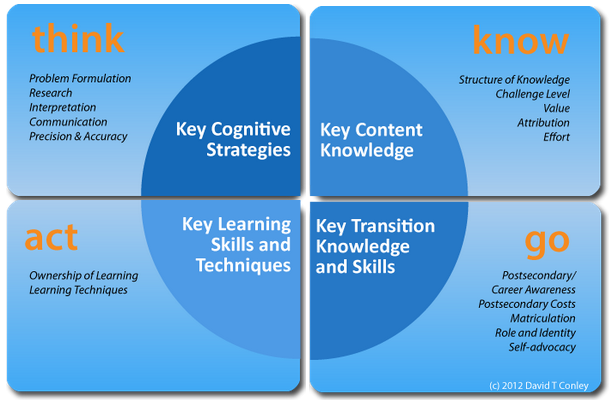
In the desire to help our nation’s kids become College and Career Ready we must consider that our assumptions about what that means ( and how to get there) may lead us to have the opposite effect of what is intended.  David Conley, a leading advocate for college and career readiness, already warns us about limiting the scope or definition of college and career readiness.  This also leads me to ask the question “Should the primary goal of a classroom teacher be to prepare their students for college? For a career? For the next year in their schooling?” Perhaps it’s semantic but isn’t preparedness a byproduct of learning?  Isn’t achievement (by whatever metric you choose to use) the byproduct of maximizing the learning potential of our students?
When we dig deeper into Conley’s definition and expectations of college and career readiness, we need to not only recognize, but embrace the seismic shift that occurred between our own schooling experience and the world our students are going to be entering into themselves. This is not to say that we weren’t prepared for the world or that our teachers weren’t very good. It’s just that the world of college and work are completely different from the ones we experienced upon graduation.


When we look at the diagram above, we must be willing to reflectively and honestly assess how much of our curriculum and instructional/assessment practices embrace all four quadrants.  Where do you see yourself philosophically? Pedagogically? What do you value? What kind of culture is being created by the choices you are making?  

Maybe this is an unfair generalization, but most secondary classrooms continue to  primarily focus on what students “know”.  The most well publicized metrics by which we currently evaluate student success  (and are now being used to evaluate our effectiveness as teachers), state standardized tests and national exams like the SAT’s, mostly measure what our students “know”. There have been attempts to move assessment measures into the “think” realm as well. But these are often difficult to write or take too long to assess with validity.  We can tell what these classrooms look and feel like because they typically involve a teacher front and center talking at students or burying kids in content without intentional instructional practices. These teachers don’t typically formatively assess and therefore can’t let classroom data  drive instruction. They don’t typically respond to student needs because they aren’t aware of them. They believe that their job is to help kids “know” stuff. And if after the test, the kids didn’t learn the stuff, it’s because the student didn’t study hard enough.

Better teachers recognize that what students “know” only matters in the context of  how they “think” about what they know. Fewer classrooms embrace the mindset that focuses more on what students do with what they know and have learned. These teachers recognize that multiple choice questions have their place, but mostly in quick checks for understanding. Teachers who aspire to have their students “show what they know” believe in performance, authenticity of assessment, and multiple and diverse  measures of success (and achievement). They also recognize that the more they talk at students, the less likely that students will have the opportunity to share their learning or what they “think”. These teachers believe:


BudLx5UIQAEz667.jpg:large


In 1778, Baron Von Steuben was given the task of whipping the ragtag Continental Army into shape. He is credited with being the father of the American military because he skillfully organized the troops through building common knowledge and instilling discipline  into the men at Valley Forge.  About the difference between European and American soldiers he is quoted as saying:  “You say to your soldier, 'Do this' and he does it. But I am obliged to say to the American, 'This is why you ought to do this' and then he does it.

Great teachers recognize that students need to be aware of context and relevance.They understand that it is as important for students to connect the content knowledge and the thinking skills to their own personal lives. These teachers challenge students to ask “Why does this matter?” or “Why should this matter to me?”  Teachers who do this conference with their students frequently and discuss content and skills in a greater context beyond academia. These teachers encourage students to explore personal interests and make connections to the curriculum and skills in the classroom and beyond.  Teachers who do this make metacognition and  student reflection a key element of their classroom design. These teachers intentionally develop a culture for students to truly be independent learners and encourage them to reflect on their goals.  In these classrooms, students make  connections between what they know, how they show it, and where they plan to “go”  when they leave their schooling behind.  

The best teachers understand that no matter what curriculum we implement, no matter what instructional and assessment practices we utilize, students can not be college and career ready if they are not the architects of their own learning.  Teachers do this by providing students authentic and meaningful choices such as which learning strategies and processes they will employ, the way in which they choose to access the  content, and how they wish to prove their learning. These teachers not only encourage students to develop their own questions, but they actively teach students how to do this better AND provide the necessary  time and feedback to become great at it.   A classroom in which the teacher and students are co-learning and collaborating together is evidence that not only is the classroom student-centered, but also student-driven. This does not mean the classroom is a free for all either. These teachers have very clear expectations of learning, are standards aligned, and provide scaffolded support too.

I’m not entirely sure what it means to be “college and career ready” yet, but I do know a few things it is not. It is not:

  • lecturing “because it’s what they do in college” (lecturing has its place but not as the primary method    of instruction or without frequent discussions and checks for understanding)
  • giving large final exams or midterms “because it’s what they do in college” (What do these types of assessments tell us about our teaching and student learning? )
  • giving lots of homework because we need to teach kids “responsibility”
(Responsibility is about doing whatever it takes to learn, not nightly assignments that have inappropriate 
cognitive demand for most learners.).
  • forcing kids into rigid coursework in the name of rigor and high standards (By all means we should afford students choice of coursework but a high level course does not guarantee high quality of learning. Rigor is about the individual students, not the course)
  • creating prescribed pathways and programs for all students (A one size fits all pathway doesn’t honor the individual needs and choices that being an independent and college and career ready learner demand)

Ultimately, if we want students to be successful  and productive adults, we need to help them to become the best learners they can be, not the best students (and there is a big difference between the two). We need to embrace the challenge that college and career readiness is going to require a different pathway for each student. We need to acknowledge that this goal is an ever-evolving and moving target as our definition of college and career readiness might already be irrelevant by tomorrow, let alone 4 years from now.  If we want our students to be college and career ready, we need schooling to be less like “school” and more like the real world. We need to afford our students the same autonomy (with support) that we as adult learners rightfully demand.  We need to ensure that our daily classroom practices and district wide processes don’t unintentionally widen the expanding gap between preparing our students for a world we can’t envision and holding onto a past that no longer exists.