Tuesday, March 26, 2013

It's not the kids who are failing.


Several years go, after participating in several cohorts of Powerful Learning Practices with Sheryl Nussbaum Beach and Will Richardson and with the support of another fantastic mentor in Robin Ellis, I realized that I had a lot of unlearning to do. One of the most challenging shifts for me to grapple with was to acknowledge that I was entirely too focused on what I was doing as a teacher and not enough on my students learning. What makes this so difficult for us as educators  is that this attitude or mindset often leaves us in an uncomfortable state of tension. That tension exists because of what we think we know to be true about teaching and what the reality of learning is for students. We know that teachers have a tremendous impact on student learning, but it's not necessarily in ways that we traditionally think.

As educators, we face a generation of students who appear to be disengaged, unmotivated, and unwilling to learn in school.  Yet, this is also a generation with more access to information,  an immense will to connect with one another and the world beyond them, and an intrinsic desire to be creative and innovative.  Our students are learning. It's just that they are doing it outside of school, without us.  Certainly there is argument on both sides of the debate as to whether this type of  less structured,  self driven learning will actually produce a generation of "well-educated" Americans (as if anyone has EVER defined that well).  Want evidence, just google the  MOOC debate occurring in higher ed. 

What has also become glaringly obvious to me is that many schools and classrooms rarely include students in  the decision making process. And I'm not referring to a Student Government or Student Advisory Council which are both fantastic opportunities for students to have a voice. How often do we ask students how they want to learn? How often do we ask students what they would like to create? How often do we involve students in the design process? How often to do we ask them to co-create rubrics or determine what success looks like in THEIR growth and learning?

As a history teacher, I love to tell stories. It's inherent in what I do and it's part of my instructional toolbelt. We know that storytelling is paramount to understanding the past and making connections to modern life, yet if the same person is always telling the story (ie. the teacher) there is little learning that is occurring. Perhaps the kids are being passively entertained. Maybe the kids are being politely compliant.  But if they aren't the ones telling the story, there is a limited chance that they will retain the story, let alone apply it or construct meaning from it. 

In the debate over what it means to be  "career and college ready"  (as defined by CCSS) most educators can agree that one of the goals is to help support successful self-directed learning and learners. Yet somehow we seem to be missing a voice, a story: the students. As educators, we know a thing or two about content and pedagogy. We attempt to marry the art of teaching with the science of teaching. We utilize the brain based research equally with what our own guts tell us. Yet despite all of our training and experience, learning is magic(al) and mysterious.  The only way to change that is to give control of learning over to the stakeholders themselves: the students. 

If we continue to make every decision for our students about what to learn, how to learn it, and when to do it, we can not call them disengaged, or lazy, or incapable of achievement. If we control every part of their school day, their lack of engagement, their lack of effort, their lack of learning is actually a reflection on us. No matter what one-size fits all strategy we employ, no matter what "traditional" teaching methods we cling to, no matter what new innovative technologies we believe will transform our classrooms, if our students do not have control over their own learning journey's, we are failing them


Tuesday, March 12, 2013

Make it work for learning.


When we discuss the purchase of technology,  one of the main debates is typically over whether we will get enough student learning for our financial investment. As we know, a SMART board does not make a smart teacher.  And putting a tablet or laptop in the hand of every child does not guarantee growth either. Realizing that this is an oversimplification of a somewhat complicated scenario, what I hear most often debated is not student readiness, but teacher readiness.The debate becomes a chicken or egg scenario. Do we buy the “stuff”  first and then professionally develop our staff so they can use it with their students or do we try and build capacity, a tipping point, and then buy the “stuff” when people are ready?
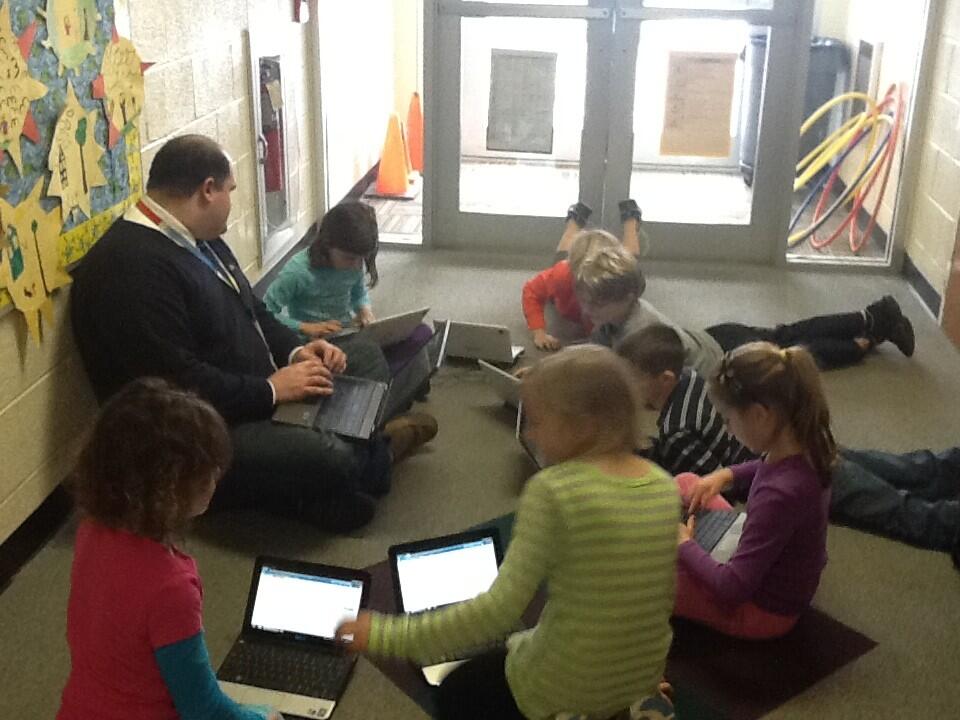
We have come to assume  that students will learn how to use the “stuff” pretty quickly. Just last week I supported some teachers who wanted to have their 2nd graders try their hand at blogging about an upcoming trip to the zoo.   I pulled a group of 8 students into the hallway and we sat on the floor exploring Kidblog together.  Before I could even begin to give them explicit directions, many of them had already figured out the wysiwig tools and were changing font colors, font size, and underlining text. This led to a great discussion about how and when to use those tools for effect in blogging.
When I asked the students how many of them had seen Kidblog before, none of their hands raised. When I asked them how many of them had ever seen the bold, or italic, or underline tool before, only 3 of them raised their hand.  I didn’t have to “teach” them how to make text bold, italic, and underline. I did need to help them explore why they might use those tools within their text.  Despite a relatively new environment, the students were willing to play. They weren’t worried about breaking anything, and they weren’t worried about failing miserably. They simply wanted to see what they could do with the tool.
As educators, we have a lot to learn from these second graders. We are sometimes given many “gifts” in the form of new hardware, software, curriculum materials, and even professional learning opportunities. And yet, for some of us, instead of opening those gifts up and playing with them, pushing them to their limits, and seeing what we can do with them, we often let them sit in a box (literally and/or metaphorically) until someone gives us the proper training on how it works. I’m not sure where we as adults lost our sense of play and our fearlessness.  I’m not sure when we became so complacent and unwilling to take learning into our own hands either.
We also need to recognize that the technologies our students might innately come to understand are not necessarily going to be used academically or appropriately out of the box either. We must also remember that not  all kids have the same experiences or access at home as they do at school.  In the end, our responsibility becomes less about learning how to make it work and more about how to make it work for learning.  


Friday, February 22, 2013

Choose Passion


When I read this excellent post by Angela Maiers (@angelamaeirs) about the passion gap recently, it helped me to reflect on how fortunate I have been to have some amazing mentors and teachers who have “metaphorically hugged me” by supporting and challenging me in support of my passions. (see @robinellis, @snbeach to name a few) I’ ve also had incredibly supportive colleagues and administrators as well. Sadly, I’ ve come to realize that my experiences are not typical in most schools or classrooms.

For many educators, William Butler Yeats’ classic quote “Education is not the filling of a pail, but the lighting of a fire.” resonates with them. Yet how often do we, as teachers, use the proverbial pail to douse and extinguish that fire inside of our students instead?  How often do we pour cold water on our colleagues ideas instead of fanning the flames? How often do administrators forcefully snuff out the innovative fires burning inside their teachers? How often do school boards or other state and federal bodies completely extinguish the fires inside the bellies of administrators who see the potential inside their schools and classrooms?

Based on that last paragraph, it would be safe to assume that “passion killing” starts at the top and  rolls down hill. In the accountability-based, standardized test driven world of education, what one does based on their passion is rarely appreciated or valued because it often can not be quantified or evaluated. Yet, those of us at the bottom of the educational  food chain, who often complain about a lack of professional autonomy and choice, professional development that doesn’t match our unique learning needs and styles, and little personalized feedback and support from our overworked principals turn around and return the favor within our classrooms.  We punish students by giving them little of their own autonomy or choice. We do not support their learning in personalized ways. And as overworked teachers we rarely give them the timely and necessary feedback needed to help them grow.

Many of us don’t want to admit this, but every one of us has a choice. Choosing to be passionate and providing that space for our students to be passionate learners is not easy in the current educational climate. It requires imagination and curiosity. It requires commitment and dedication. It requires data and evidence. It requires self awareness through reflection and adaptability to make necessary changes. It requires effort  and perseverance. It requires trust and faith. And most importantly, it requires courage. (See habitudes).

In all the rhetoric surrounding education reform these days, the words of Sir Ken Robinson always ring out to me:

“The fact is that given the challenges we face, education doesn't need to be reformed -- it needs to be transformed. The key to this transformation is not to standardize education, but to personalize it, to build achievement on discovering the individual talents of each child, to put students in an environment where they want to learn and where they can naturally discover their true passions.”


As educators, we must love our students and one another enough to embrace this vision and work tirelessly to make it a reality for every child. We must create classroom and district  cultures and climates that embrace inquiry and authentic opportunities of learning. We must be reflective enough to see the many ways we destroy our students and colleagues passions and then have the courage to change those practices.  We must shine a light on and reject the systemic processes  that do the same and work vigorously, professionally, and passionately to change them. And we must do this together. Living in a world with a passion gap is not acceptable for us or for our kids. We all have a choice. Choose passion.


Wednesday, February 13, 2013

How transparent is your classroom?


If you asked teachers about the transparency of their classroom, it would most likely be low on their list of priorities.  And that’s a shame. In the high-stakes accountability driven world educators currently operate in, the tendency has been to hunker down, close the door, and hope that no one notices you long enough to make you endure yet another series of frustrating changes.  At the same time, what if instead of crawling back into the caves, we took another approach?  What if instead of hiding, we did the opposite? What if chose to shine a light on  the learning that is occurring in our schools and classrooms?
The philosophical shift to building a more transparent classroom is not an easy one. It takes courage and resolve and a belief that by sharing everything (warts and all), the classroom will become an optimal learning environment for both a teacher and their students.  There is a vulnerability that comes with transparency as well as humble acknowledgment  that we may not have control of or even understand the magic of learning in our classrooms. Let’s take a look at some ways we can begin to move towards more open and transparent classroom environments.

1) Document everything.  Evidence of learning comes in many shapes and sizes these days.  Technology affords us the ability to document all of it. Use your cell phone to take photos, video and audio recordings. Instead of focusing on grading student work, provide feedback to them while “collecting” it.  Focus less on recording numbers in a gradebook and instead focus more on what these artifacts mean for your learners.  In itself, documenting everything does not make you transparent, but it is a necessary practical first step. Record your mini-lessons and small group conversations so that absent students can view them later on. Remember, students who need extra support also have this resource to go back to and view at their own pace. They have the advantage of pausing, rewinding, and re-watching the lesson.  Even more important than teachers documenting evidence, we must provide students the opportunity to document their own learning journeys.  Let them give one another feedback through digital collaboration tools or peer evaluated rubrics. Let them pull out their cell phones and support them in creating their own understandings through media and evidence collection. Again, documenting everything does not make your students learning more transparent, but it does begin to create larger conversations about quality, revision, and publishable products.

2) Create a digital learning community. Many teachers have moved towards Learning Management Systems such as Blackboard, My Big Campus, Schoology, and Edmodo (for example).  These environments allow for continued collaboration and communication and provides opportunities for students and teachers to continue to interact after the school day ends. Most LMS’ are “gated” communities which allow for students to have a safe place to share their work without making it available on the web immediately. Think of these as playgrounds or sandboxes for kids to work and play. They should be places where kids can take academic risks and make mistakes. While many teachers and students prefer to have these communities be open to students and teachers only, some of them provide opportunities for parents or community members to participate as well.

3) Digital Portfolios of Learning.  Student portfolio’s are not a new idea but have often been locked away in a classroom closet or drawer only to be pulled out at parent-teacher conference time. We need to be helping students create digital portfolios that are dynamic, visible, and showcase both evidence of the learning journey as well as published final products. Through the use of google sites or wikispaces (though there are many others), students can create spaces that provide opportunities for feedback from peers, teachers and/or experts. What is key is that no matter what tool you use, the students should determine the visibility of their work, while you encourage openness.

To do this though, we need to practice what we preach. Imagine that teachers modeled this by making their lesson plans, brainstorms, assessments, and rubrics available for colleagues. What if teachers recorded their most effective strategies and best practices as exemplars for peers to view?  What if teachers posted videotaped  parts of lessons to receive constructive feedback from their colleagues? How could digital teacher portfolios of learning help us to continuously improve?

4) Blog. Teachers and students alike should consider blogging because it helps make our thinking and learning visible. We need to be more reflective as professionals and we need to model and encourage reflection for our students.  The best teacher blogs are ones that share insight into the classroom experience, sharing the ups and downs, the successes and failures.  Consider that by having a blog, other teachers just like you might have the courage to try something or learn from you.  Blogging is one of the most transparent and scary things we can do as educators. It is also one of the ways we can regularly communicate with and invite parents into our classrooms and the insights we bring to our profession. For students, it provides them a voice and an opportunity to very publicly wrestle with questions and concepts for an audience far greater than their teacher and classmates.

5) Use Social Media.  It is becoming more common for districts and schools to use social media to communicate with parents and the community . Teachers should consider the use of social media not just because it can be effective communication tool with students and parents, but also because it provides us an opportunity to model how to use these tools for learning. Twitter and Facebook (for example)  provide platforms to share resources and information as well as celebrating the fun and learning occurring inside of our classrooms.  

In the end, transparency in teaching is mostly about sharing. Sharing learning spaces with kids, sharing ideas with colleagues, and sharing success with parents.  As educators we must challenge ourselves to be more open to sharing and transparent in our thinking so that all stakeholders can continue to learn and grow.


(This blog is cross posted at the Digital Learning Blog as well)

Thursday, February 7, 2013

How do we maximize student effort the first time around?


Being a part of a school district who made the commitment to be fully K-12 standards based five years ago has (to put it mildly) brought many ups and downs.  Implementation of any one radical educational shift and philosophy can bring heartache and struggle, let alone attacking multiple sacred cows at the same time.  Removing zeros from our repertoire, separating academic achievement from behavior, and eliminating extra credit just to name a few.  Although some of those shifts were easier than others, there are a few places where we are still trying to take the ideal (and ultimately best for our learners)  and make it real inside our classrooms.  We know that providing students multiple opportunities to show evidence of their growth or learning is right and best for kids, but what does that look like with jam packed classrooms and jam packed curriculum's?  And what do we do when students who know they will have opportunities to revise or remediate take advantage of that by not doing their best work the first time around? 

We have been very fortunate to have some experts help define our core philosophies and support us in our learning journey over the past few years: notably Rick Wormeli (@rickwormeli) and most recently Dylan Wiliam (@dylanwiliam).  On Tuesday,  Dr. Wiliam answered questions and engaged in conversations with teachers and administrators at all levels  around some of the issues mentioned above, but the conversation weaved its way into many concerns and questions above and beyond assessment practices.  I have done my best to summarize and categorize  Dr. Wiliam's perspectives and the learning that occurred from this unique experience.  (My apologies to Dr. Wiliam if I didn't quite get it all right.) Below are my takeaways. 


1) A student's willingness to complete work to the best of their ability (or at all) is a reflection of the culture a classroom teacher creates for that individual student. As teachers we have a moral obligation to know each of our students as people and more specifically as learners. When students are not learning, we need to question and challenge ourselves to not only diagnose what is getting in the way, but do something about it. Many of us believe that daily conferencing with a child is important (and could help us determine what is getting in the way for that child) but the structure of our classroom may not allow for that to happen. If our structures (re: too much teacher directed lecture) get in the way, we must change them. We need to be open to asking ourselves if we are getting in the way of our students learning and then be courageous enough to get out of the way.
2) A teacher does not have the ability to motivate a child to learn intrinsically. This will be a hard pill to swallow, but ultimately the best we can do is create a climate or culture that supports each students ability to learn. How do we do this? Dr. Wiliam gives us a clue when he tells us that this happens through "engagement and responsiveness". We need to provide actionable feedback that encourages effort and growth. As teachers, we must also question whether our use of extrinsic rewards (ie. grades, bribes, competition) are detrimental to our students ability to tap into their intrinsic desires to learn. 
3) Students will complete tasks on time and to the best of their ability when they have skin in the game. How often do you provide students choices in your classroom? How much of what happens in your classroom is done without asking for student input? Do you allow your students to show what they know and can do in ways that make sense to them? How often do students have input in the creation of an assessment? What about the rubric or evaluative process? Do you encourage students to ask deep meaningful questions surrounding your curriculum and then support them in grappling and ultimately answering them? How much control are you willing to give to students in support of their learning?
4) Creating a culture that encourages and supports risk taking and failure is a place where learning happens. A classroom where students are encouraged to take risks and are supported when they fail (instead of sorted by grades and/or made to feel as if they aren't smart enough) will help students to want to try their best the first time because the goal becomes solving the problem and/or about improvement. As teachers, our job is to help students challenge themselves as well as pushing them to places they themselves did not think was possible. As Dr. Wiliam reminds us, "The difference between a good violinist and a great violinist is that while good violinists practice what they can do, great violinists practice what they can't do." Are we creating meaningful opportunities for our students to try and do what they can't yet do?
5)"We are preparing our students for a future we can't even imagine" (D. Wiliam) The goal of many "traditionalists" is to return us back to a place where memorization and lecture were king and that the only way our students can be prepared for the real world is to force them to learn information by cramming it down their throats, practicing things over and over through drill and kill, thus destroying any chances of a student being prepared for a world in which innovation and creativity are becoming even more essential for success. To those who seek to punish students into understanding the harsh realities of a world where deadlines are real and no one ever gets second chances, here is my challenge to you: Don't just settle at having real world consequences, make your classroom a place that reflects the kind of work done in the real world. Provide opportunities for your students to collaborate and design, create and problem solve, explore and troubleshoot, play and fail, innovate and celebrate. Have them do it for an audience that represents real- world conditions with real-world experts. Have them do it transparently so others can evaluate their work and provide feedback.
Remember: just because we can't quite envision the future for our students doesn't mean we should hold them back from creating and defining it for themselves.


Tuesday, February 5, 2013

A confession and a thank you to my PLN


When you are an educator, there are certain inevitabilities that come with the job. Your mama told you there were would be days like this, and if you are like me, when you have “one of those days”, it can be disheartening.  For too many of us, they paralyze and defeat us.  When I am feeling exhausted and broken, I look to “sharpen the saw”  and I seek inspiration. Traditionally, I have gone to my family and closest friends for counsel, advice and motivation. And while they will never be replaced, I have found myself  going to my twitter PLN for inspiration more and more these days. On the surface, twitter can seem like a whole lot of noise, a lot of style with no substance, and the vast amount of links and resources shared can be incredibly overwhelming.

My PLN inspires me. It gives me hope. It shows me that the classroom and educational experience I want for all kids is a shared dream and that there are many educators “out there” who work incredibly hard to make that dream a reality for their students.   Connected educators (if this term means little to you, read this) are able to tap into the greatest community of knowledge, ideas, experience, and wisdom in educational history.  It’s not without it’s negatives, as Karl Fisch recently pointed out.

While my PLN inspires and motivates me, it doesn’t do the work for me. It doesn’t create change in my classroom and it doesn’t change my approaches in coaching and supporting colleagues.  It’s not a magic bullet. I still have to do the work. All those amazing ideas out there I want to play with? I still have to learn more about them. I still have to explore how they all fit  and work for my students and colleagues. I still have to spend hours understanding and experiencing  them.  I still have to try them and fail and pick up the pieces and try them and fail some more.

And there is the rub.
But this is also where the learning occurs.  

Far too many of us are waiting for a knight in shining armor to come rescue us from unfunded mandates and initiative fatigue. We are waiting for a hero to scoop us up and protect us. We are waiting for professional developers to hand everything to us on a silver platter. We are waiting for things to go back to the way they used to be.  

If you find yourself nodding along to any of these sentiments, you will be waiting for a long time.

It also means you might be stuck.

My PLN reminds me that while no knight in shining armor is coming, I must never give up the desire of continuous improvement for myself, for my students and in support of my colleagues.  They remind me that I want to be on the road that leads to awesome. (see clip above) They remind me that I need to be the hero of my own story. My PLN reminds me that I am the architect of my own learning journey. Most importantly, they illuminate a future full of possibilities that are far greater than any past we seem to remember.

I have a confession to make.  I’ve had an active twitter account for over 4 years now. I have tweeted only 417 times as of this post.  I have taken from my PLN far more than I have given. I have hoarded links and insights and silently observed. I have offered very little worth.  I could offer a series of excuses here as to why I haven’t shared a whole lot. The truth is, I was scared. I was afraid that I would add nothing of value to the conversation. I was afraid of how others would view and judge me.   These are also the reasons why I started countless blog posts only to delete them.   

For many in my PLN, hitting tweet or posting reflections publicly comes naturally by now. It just took me longer to get there. (OK, a LOT longer.)   So consider this my thank you for your patience. My PLN motivates me to be an empathetic and reflective learner with a passion for knowledge, understanding,and seeking continuous improvement. It inspires me to be a better teacher and colleague. Thank you to you all.

Wednesday, January 30, 2013

Giving time to save time


After sharing my thoughts on how changing our assessment practices and eliminating time spent at the copier can provide us more time in our daily lives, let’s explore the biggest time killer in teaching today: how we communicate.

According to many teachers, the sheer amount of email we receive on a daily basis can be overwhelming and almost impossible to sift through. So how can we ease that pain? Here are a few tips: first, we can learn to create and use distribution lists ensuring that emails intended for the right people are only seen by those whom need to see them. By doing this, we also make sure that we get less email ourselves. We can also find ways to make our email more organized and efficient by organizing folders and creating rules.

Secondly, we need to consider the content of our email. Many emails I receive are of the sharing variety. I love these emails. But there are more efficient ways of sharing cool sites or great articles. Using social bookmarking tools such as diigo or delicious not only allow us to curate the web, they also allow us to build upon each others findings. Imagine finding a great article about the best instructional practices in a specific content area. In the past we have emailed it to each other and perhaps written a few responses back and forth. But using diigo and delicious, I can comment directly on the article, highlight what I think is important and share it with anyone (or entire groups of people) for their responses too. The articles or website becomes a living and breathing document in which we are learning alongside one another. Another bonus is that all of these articles and websites are searchable by keyword. No more wasting time going back into my email spending 15 minutes searching for that great link you sent me.

Another huge time waster is how we spend our time when we are face to face. In this post from the beginning of the year, Kristen Swanson shares “must haves” for faculty meetings. These “must haves” should apply to any PLC’s or teacher led meetings we have as well. Does your PLC or team meeting have:

  •  an agreed upon agenda created in the days/weeks prior to the meeting time 
  •  a defined start and end time 
  • agreed upon roles for each member of the group 
  • an agreed upon vision that focuses conversation 

But even beyond these structures, how well do we adhere to them? Does each member of the group commit to adding their ideas or questions prior to meeting time (using a shared Google Doc makes this MUCH easier). Does every member of the group come on time? Do members of the group leave early? How often do we get off topic instead of being focused on the tasks at hand? How often does the conversation devolve into complaints about a myriad of topics that do not lead to solutions to our problems? Teachers are often frustrated with the lack of time they are afforded to truly collaborate. Yet how much of our time is often wasted by any number of the factors above? How much of this do we, ourselves, own? My challenge to each and every one of us is to count the minutes we spend complaining instead of doing this week. Imagine how much more effective we could be if we spent that wasted time on any number of things: reflecting, working with struggling students, performing random acts of kindness for our colleagues, calling a parent to let them know how proud we are of their child, building and learning from our PLN.


Finally, the biggest time waster comes from our lack of willingness to truly collaborate and share. We live in an age where technologies afford us the ability to access and share unlimited content, collaborate in real time not only across the building or district but around the world, and we can expose ourselves to a diversity of opinions and perspectives. Yet we often revert back into a “closed-door and leave me alone to teach” mindset. This mindset prevents us from growing professionally and ultimately hurts our students.

A wise colleague once asked the question (in reference to professional development) “What can we do in a faculty meeting we wouldn’t normally be able to do? What can we do on a non-instructional day we wouldn’t normally be able to do?” We must ask this same question of the face to face collaboration time we are either afforded or create for ourselves. If it can be done a different way, an easier and less time consuming way, it should be. Ultimately though, we cannot complain about how little time we have and yet turn our backs on collaboration with peers. Anything we do together should not only save us time, but be better for our students. How can working together to design meaningful and authentic learning experiences be bad for us or for our students? How can sharing assessment results (ie. data) and developing a diverse and effective instructional tool belt to meet the needs of all of learners not be worth our time?

I realize that the structures of our school day here in America may not afford us the kind of time to collaborate we wish we had. Is this what really gets in the way? Our professional growth (which leads to student learning) is not something we should be waiting for others to provide for us. It’s not a once a month faculty meeting kind of thing. It’s not a four times a year non-instructional day kind of thing. It’s not even a once a week department or team meeting kind of thing. It’s a mindset. It’s a fundamental core belief that we are the architects of our own learning journey. And that in sharing that journey with others, we make the time to be effective and inspiring educators for all of our students. We collaborate because by learning alongside one another, we create opportunities for kids that we could never dream of on our own.